
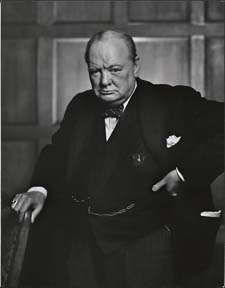
Winston Churchill Becomes British Prime Minister
Battle of Britain
Roosevelt Elected to Third Term
Selective Service Act
Regions Begin Conducting Broker-Dealer Inspections
SEC Enforces PUHCA
Investment Company Act and Investment Advisers Act
Enacted on August 22, the Investment Company Act required organizations engaged primarily in investing and trading stocks to give full disclosure about investment objectives and minimize conflicts of interest. The measure also required investment companies to maintain certain books and records and to allow for their inspection. The Investment Advisers Act required investment advisers to register with the U.S. Securities and Exchange Commission before providing services. Congress, concerned about the effect of widespread redemptions on the market, placed limits on the size of mutual funds, but the industry gained the ability to maintain retail prices of funds.
National Committee of Investment Companies

Winston Churchill Becomes British Prime Minister
Lend-Lease Act
Siege of Leningrad
Japan Attacks Pearl Harbor
NYSE Multiple Trading Rule
After lengthy negotiations, the SEC persuaded the New York Stock Exchange to suspend this rule—imposed in the 1930s but only recently enforced—intended to protect the NYSE monopoly by preventing members from trading in listed securities on other exchanges.
NYSE Board of Governors Advisory Committee
NASD Uniform Practice Code

"Final Solution" for Jews
U.S. Interns Japanese-Americans
Manhattan Project
Battle of Midway
Battle of Stalingrad
SEC Relocates to Philadelphia
Rule 10b-5 Adopted
Wickard v. Filburn
Proxy Access Initiative

Warsaw Ghetto Uprising
Casablanca Conference
Benito Mussolini Deposed
Withholding Tax on Wages Introduced
Regional Offices Issue Regulation A Exemptions.
The 1933 Act allowed the Commission to offer conditional exemption from full registration to issuers of up to $100,000 in securities. On April 22, 1938,the SEC adopted Regulation A, enabling small issuers to file limited exemption documentation. By 1943, “Reg A” exemptions accounted for a large part of the workload at many regional offices.
New York Regional Office and the Shingle Theory
In its Charles Hughes v. SEC decision, the Second Circuit upheld the SEC’s “shingle theory,” asserting that any securities firm “that holds itself out as competent to advise” must disclose market prices. Although the Hughes case, brought by the New York Regional Office, was not the first case to draw upon shingle theory, it marked the point at which the concept became accepted within American jurisprudence.

D-Day
Battle of the Bulge
Bretton Woods Conference Creates International Monetary Fund and World Bank
GI Bill of Rights
Delaware Limitations on Shareholder Actions
Delaware General Corporation Law Section 61-b limited shareholder derivative actions against a corporate board by requiring a plaintiff to own at least 5% of a corporation’s shares or more than $50,000 in stock. This state statute provided a template for some of the restrictions on securities fraud class actions introduced by the Private Securities Litigation Reform Act (PSLRA) in 1995.
SEC Limits NASD Discipline
In its Public Service Company of Indiana decision, the U.S. Securities and Exchange Commission overruled a National Association of Securities Dealers disciplinary measure, finding that enforcing minimum prices was not a legitimate role for a self-regulatory organization.
Test of Tax Immunity of Municipal Bonds
In IRS v. Shamberg’s Estate, the Second Circuit Court of Appeals upheld the immunity from taxation of Port of New York Authority bonds. The U.S. Supreme Court refused to hear the case, allowing the constitutional barrier to federal taxation of municipal bonds, established in its 1896 Pollock v. Farmers Loan and Trust decision, to stand.

Roosevelt Dies – Harry Truman President
Yalta Conference
United Nations Founded
U.S. Drops Atomic Bombs on Japan
World War II Ends
SEC Battles NYSE
SEC Limits Application of Accounting Standard for Taxes

Nuremberg Trials
Churchill’s “Iron Curtain” Speech
Philippines Gain Independence from U.S.
Benjamin Spock’s “Baby and Child Care”
James J.Caffrey Becomes Chairman
On July 23, James J. Caffrey, who had served two years as regional administrator in Bostonand seven as regional administrator in New York, became Chairman of the SEC. Although Caffrey served only one year as chairman, his appointment marked the beginning of a 25-year period in which regional offices enjoyed a great deal of autonomy within the Commission.
SEC v. W.J. Howey
The U.S. Supreme Court’s decision in SEC v. W.J. Howey defined a “security” under federal securities laws. It provided for the test for the existence of an “investment contract,” one of the most important instruments listed in the statutory definition of a security.
NASD Registration of Broker Representatives
The U.S. Securities and Exchange Commission allowed the National Association of Securities Dealers to register individual broker representatives, in addition to broker-dealer firms, expanding the NASD’s authority over the industry.
Landis v. North American
Eleven years after the passage of the Public Utilities Holding Company Act, the U.S. Supreme Court upheld the U.S. Securities and Exchange Commission’s power to break up utility holding companies.
Administrative Procedure Act
Congress passed the Administrative Procedure Act, establishing legal procedures and requirements for administrative action, including requirement of “substantial evidence” and providing for judicial restraint of “arbitrary and capricious” decisions.

X-1 Breaks Sound Barrier
Marshall Plan
Hollywood Black List
Jackie Robinson Integrates Baseball
India and Pakistan Gain Independence
First Branch Offices Open
With the workload ofthe SEC’s ten regional offices increasing, during fiscal year 1947 the Commission established satellite facilities, which handled investigatory work, in Detroit, Los Angeles, St. Paul, Tulsa, and St. Louis. Each “branch office” reported directly to a Regional Administrator.
Hoover Commission Report
The Commission on Organization of the Executive Branch of the Government, known as the Hoover Commission after its chair, former President Herbert Hoover, reported that the U.S. Securities and Exchange Commission had a backlog of unreviewed corporate reports and was unable to examine brokers on an annual basis, in part due to the shrinkage of the agency’s staff and budget following World War II.
SEC Challenges Accounting Standards
The U.S. Securities and Exchange Commission disagreed with the American Institute of Accountants’ Committee on Accounting Procedure (CAP) over whether unusual and extraordinary items were best displayed before net income, in the SEC’s view, or after net income, in the CAP’s view in its Accounting Research Bulletin 32. The SEC Chief Accountant announced that the SEC would take exception to financial statements that appeared to be misleading, even if they reflected the application of CAP’s bulletin.

Berlin Airlift
State of Israel Founded
North and South Korea Divided
Gandhi Assassination
Racial Segregation Ends in U.S. Military

People's Republic of China Founded
NATO Established
South Africa Institutes Apartheid