
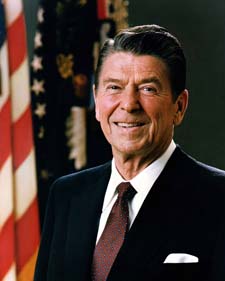
Ronald Reagan Elected President
CNN Begins Broadcasting
Iran-Iraq War
Off-Board Trading Restrictions Relaxed
Chiarella v. U.S.
In Chiarella v. United States, the U.S. Supreme Court ruled that a printer who learned of a tender offer while preparing materials for the bidders and bought shares of the target company before the information became public was not an insider who could be charged with a violation of Rule 10b-5. The court held that mere possession of nonpublic information did not give rise to a duty to either disclose such information or refrain from trading.
12b-1 Fees

Sandra Day O'Connor First Woman U.S. Supreme Court Justice
Iranian Hostages Released
AIDS Identified
Assassination Attempts on Reagan and Pope John Paul II
Central Registration Depository
A joint project of the North American Securities Administrators Association and the NASD, the Central Registration Depository (CRD) allowed state and federal regulators to share information about broker-dealers with each other.
Regulatory Relief Task Force
To meet his campaign promise to “get the government off the backs of the people,” President Reagan established the Task Force on Regulatory Relief, led by Vice President George H.W. Bush. The Task Force was charged with examining the effects of each government regulatory agency on industry.

Falklands War
Futures Trading Act
Supreme Court Invalidates Illinois Takeover Act
Following the Williams Act, many states adopted their own statutes regulating takeovers. In Edgar v. MITE Corp., the U.S. Supreme Court ruled that the Illinois Business Takeover Act had been pre-empted by the Williams Act and imposed an unconstitutional burden on interstate commerce.
Nasdaq National Market System
Garn-St. Germain Depository Institutions Act
Shelf Registration
Gartenberg v. Merrill Lynch
In Gartenberg v. Merrill Lynch, the Second Circuit Court of Appeals found that for mutual fund fees to be excessive under Section 36(b), they had to bear “no reasonable relationship to the services rendered.” In 2010, the U.S. Supreme Court upheld the ruling in Jones v. Harris Associates L.P..

Sally Ride First U.S. Woman Astronaut
U.S. Invades Grenada
Benigno Aquino Assassinated
Dirks v. SEC
The circumstances under which a tippee would be liable for trading on material non-public information were addressed by the U.S. Supreme Court in Dirks v. SEC. The ruling limited liability to situations in which the tipper was acting to receive a personal benefit in breach of a fiduciary duty.
TEFRA Eliminates Bearer Bonds
A provision of the 1982 Tax Equity and Fiscal Responsibility Act eliminated all bearer securities, effective in 1983, encouraging the municipal bond market to move from paper certificates to electronic book-entry issuances, and opening the way for increased bond trading and more effective disclosure.
WPPSS Default
Tender Offer Advisory Committee

Macintosh Computer
Bhopal Gas Leak
Indira Gandhi Assassinated
Bell Telephone System Broken Up
SOES
Insider Trading Sanctions Act
Dingell Hearings
After the collapse of the savings and loan industry, U.S. Representative John Dingell (D-MI) held hearings to investigate whether the federal government should take over issuance of accounting standards and oversight of auditors.
Emerging Issues Task Force

Mikhail Gorbachev Institutes Glasnost and Perestroika in USSR
Treadway Commission
The Committee of Sponsoring Organizations (COSO) was organized to sponsor the National Commission on Fraudulent Financial Reporting. The National Commission was known as the Treadway Commission after its first Chairman, former SEC Commissioner James C. Treadway, Jr. The Treadway Commission studied the causal factors that can lead to fraudulent financial reporting, and concluded that improvements were needed in corporate reporting on internal controls, independent audit committees, auditor detection, reporting of fraud and auditor quality. In 1992, COSO published Internal Control – Integrated Framework, establishing a common definition of internal control that serviced the need of different parties for assessing and improving their control systems. The framework was revised and reissued in 2013.
Revised Uniform Securities Act
Poison Pill
A shareholder rights plan, nicknamed the “poison pill,” was developed in the early 1980s as a defensive tactic used by a corporation’s board of directors against a hostile takeover. In 1985, the Delaware Supreme Court upheld poison pills as a valid instrument of takeover defense in Moran v. Household International, Inc..
Non-Bank Bank Hearings
Council of Institutional Investors
Pension fund stewards – such as Harrison Goldin, Comptroller of the City of New York; John Konrad, State of Wisconsin Investment Board; and Jesse Unruh, California State Treasurer and trustee of the California Public Employees Retirement System (CalPERS) – founded the Council of Institutional Investors to bring the power of institutional holdings to bear on corporate governance reform.

Challenger Explodes
Chernobyl Nuclear Accident
Corazon Aquino Elected President of Philippines
Instinet No-Action Letter
Proposed Tax on Municipal Bond Interest
Tax Reform Act
The Tax Reform Act of 1986 changed the tax benefits of securities and financial transactions, and eliminated many forms of tax shelters. The Act had a profound impact on the structure of the municipal securities market. Provisions of the act sharply curtailed the issuance of industrial development bonds, eliminated commercial banks as buyers of municipal securities and, to a lesser extent, limited participation in the market by property/casualty insurers. The municipal securities market ceased to be dominated by institutional buyers and became retail-oriented. The inability of many dealer firms to profit from secondary trading activity put pressure on them to obtain negotiated underwriting business, contributing, in turn, to incentives to make political contributions and pay kickbacks.
Investigation of Pyramid Schemes
E. F. Hutton Settlement
“Calling for Your Dollars”
With an increasing number of investors falling prey to “boiler room scams,” the North American Securities Administrators Association released Calling for Your Dollars, a short educational film that showed common fraudulent telephone sales tactics and encouraged would-be investors to hang up if a pitch sounded too good to be true. Regarded as the first investor education film, Calling for Your Dollars helped lay the foundation for further investor education efforts.
One Share, One Vote

Iran-Contra Hearings
’34 Act Claims Subject to Arbitration
Shearson/American Express v. McMahon established that agreements to arbitrate customer claims against securities firms, brought under the ’34 Act, were enforceable.
Kansas Municipal Issuer Attempts Call
October Market Break
NASAA Model Uniform Rules
NASAA Moves to Washington
Supreme Court Upholds Indiana Takeover Act
In CTS Corp. v. Dynamics Corp. of America, the U.S. Supreme Court upheld an Indiana law that allowed Indiana-chartered corporations with significant numbers of Indiana shareholders to opt into a protective scheme, forbidding an acquirer of a controlling block of shares the ability to use the voting power of those shares to appoint a new board of directors. A majority of the court also found that the Indiana statute was not preempted by the Williams Act, making it clear that states could pass laws that in some way restricted these transactions, so long as they were reasonable and did not interfere with that the federal law’s goals.

George H.W. Bush Elected President
Global Warming Warning
Terrorist Bomb Explodes Plane Over Lockerbie
Anderson Committee
The AICPA commissioned the Special Committee on Standards of Professional Conduct, led by former AICPA Chairman George D. Anderson, to recommend reforms to professional standards for the accounting profession. It recommended mandatory peer review and created the Plan to Restructure Professional Standards in 1989.
“Fraud on the Market”
In Basic, Inc. v. Levinson, the U.S. Supreme Court held that private plaintiffs could be permitted to plead that they had been injured by reason of the market effects of a fraudulent statement of which the plaintiffs themselves had been unaware. The “fraud on the market” theory had a significant impact on class-action lawsuits.
ITSFEA
Rule 19c-4
Dual class capitalization allowed a corporation to issue stock with different voting characteristics. Rule 19c-4 limited the ability of corporations to deviate from one share, one vote. The rule was struck down in 1990 by the District of Columbia Court of Appeals in Business Roundtable v. SEC.
Penny Stock Task Force
State Exemption for Nasdaq Trading
The North American Securities Administrators Association and the NASD established criteria to allow shares traded on Nasdaq to be exempted from state securities registration requirements. A Memorandum of Understanding between NASAA and the NASD determined the factors for exemption of securities from state registration requirements and designated those exempt securities as Nasdaq National Market System securities.
SOES Bandits
NASD made its Small Order Execution System (SOES) mandatory after the 1987 market break. Private traders – dubbed “bandits” – profited by jumping ahead of market makers.
Federal Taxation of Municipal Securities
In South Carolina v. Baker, the U.S. Supreme Court found that the Constitution does not forbid federal taxation of municipal securities.

Exxon Valdez Ruptures
Tiananmen Square Massacre
Berlin Wall Falls
World Wide Web Server and Browser
’33 Act Claims Subject to Arbitration
Reversing the 1953 Wilko decision, the U.S. Supreme Court ruled in Rodriguez De Quijas v. Shearson/American Express that agreements to arbitrate ’33 Act claims are enforceable.
Rule 15c2-12 Regulates Municipal Underwriters
Ethical Deregulation
The U.S. Department of Justice and the Federal Trade Commission sought to force professional organizations to repeal rules banning advertising, solicitation and competitive bidding. The American Institute of Certified Public Accountants entered into a consent agreement with the FTC to lift its prohibitions regarding contingent fees, commissions, referral fees, advertising, solicitation and trade names.
Keating Fraud
FIRREA
Federal Taxation of Municipal Securities
In South Carolina v. Baker, the U.S. Supreme Court found that the Constitution does not forbid federal taxation of municipal securities.