
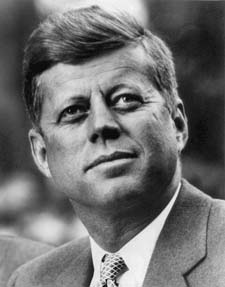
John Kennedy Elected President
U-2 Spy Plane Shot Down Over Russia
Adolf Eichmann Captured
Greensboro Sit-In
Birth Control Pill Approved for Contraceptive Use
Report on Regulatory Agencies
President-Elect Kennedy asked former SEC Chairman James Landis to write a report on the U.S. Securities and Exchange Commission and other federal regulatory agencies. The report emphasized the importance of hiring adequate and experienced staff for the SEC, as well as the negative repercussions of an under-budgeted agency.
Investment Advisers Act Amendments
After a campaign by the SEC, Congress passed Public Law 86-750. The Investment Advisers Act Amendments gave the Commission greater powers to regulate advisers, most importantly the ability to require investment advisers to keep certain books and records, and to submit to periodic examinations of them.

Berlin Wall Erected
Bay of Pigs
Peace Corps
Freedom Rides
OPEC Formed
Gagarin First to Orbit Earth
Re Scandal
The Res, a father and son team of American Stock Exchange specialists, had been engaged in illegal activity in connection with the securities markets since the early 1950s. The U.S. Securities and Exchange Commission learned of some of their activity in 1957 and imposed minimal penalties. In 1960, the SEC began a full-scale investigation of the Res. The Res were expelled from the AMEX and, after a criminal trial, sentenced to prison. The SEC came under criticism for not taking effective action earlier. The Re scandal questioned the efficacy of of self-regulation.
Cady, Roberts & Co.
Cady, Roberts & Co. was a U.S. Securities and Exchange Commission administrative proceeding involving a broker who traded an exchange-listed security while in possession of inside information. While the SEC had rarely used Rule 10b-5 since its enactment, in Cady, Roberts, the SEC made clear that Rule 10b-5 applied to transactions occurring over stock exchanges and not just to transactions made face to face.
Branch of Special Investigations
In October, concerned that the regionally fragmented nature of the enforcement program kept the SEC from going after large-scale fraudsters, Chairman William Carey createda Branch of Special Investigations within the Division of Trading and Exchanges to assist regional offices—and in some instances take over—cases of national importance. This signaled the waning of regional office autonomy within the SEC.

James Meredith Registers at University of Mississippi
Cuban Missile Crisis
Rachel Carson’s “Silent Spring”
Second Vatican Council
Telstar Transmits First Transatlantic Television
American Stock Exchange Investigation
Following the Re scandal, the U.S. Securities and Exchange Commission conducted an investigation of the American Stock Exchange, attributing the AMEX problems to a small group of specialists, and proposed decreasing the role of specialists in management positions.
Wharton Study of Mutual Funds
The Wharton School of Business was commissioned by the U.S. Securities and Exchange Commission in 1958 to conduct a study of the mutual fund market. The study, published in 1962, found that the performance of the mutual funds examined did not exceed the performance of a randomly selected portfolio of securities, nor did higher management fees result in better performance.
Market Break
On May 28, the Dow Jones Industrial Average fell 5.7%, the second-largest point decline then on record. Volume was so heavy that the “ticker” did not finish reporting until two hours after the market closed. A report by the U.S. Securities and Exchange Commission found that specialists stopped trading when liquidity was urgently needed.

Kennedy Assassinated – Lyndon Johnson President
Special Study of Securities Markets
The U.S. Securities and Exchange Commission released the Special Study of Securities Markets. About 40 staff members worked on the study full time for two years. The study was conducted on a quasi-independent basis and issued without the prior approval of SEC Commissioners. The study questioned the effectiveness of self-regulation and the ability of exchanges to adequately protect investors. It criticized the SEC’s passivity in supervising exchanges and found that the SEC had not adequately enforced rules against large securities firms.
Supreme Court Limits NYSE Antitrust Exemptions
In Silver v. New York Stock Exchange, the U.S. Supreme Court limited New York Stock Exchange antitrust exemptions only to areas that fulfilled the exchange’s obligations under the Securities Exchange Act of 1934.
Investment Tax Credit Accounting
The U.S. Securities and Exchange Commission announced in Accounting Series Release No. 96 that it would accept a method of accounting for the investment tax credit that had been outlawed by the AICPA’s Accounting Principles Board. The Board accommodated the SEC’s view in APB Opinion No. 4, but tried again in vain when the investment tax credit was re-introduced in 1967 and in 1971. Congress intervened by including a provision in the Revenue Act of 1971 that no taxpayer should be required to use any particular method of accounting for the investment credit in its financial statements.
Markets Close with News of Kennedy Assassination

Civil Rights Act
Supreme Court Rules on Private Actions
In J.I. Case v. Borak, the U.S. Supreme Court held that the Exchange Act implicity authorizes a private right of action for false and misleading proxy statements issued in violation of Rule 14a-9. The ruling meant that individuals could sue and seek damages from other people or corporations that violated certain securities laws. The Court reasoned that private suits would supplement the U.S. Securities and Exchange Commission’s efforts in enforcing securities laws and deterring violators.
Securities Act Amendments
In response to the Special Study of Securities Markets, Congress enacted the Securities Act Amendments of 1964. The most significant amendment extended reporting requirements under the Securities Exchange Act of 1934 to firms that were unlisted on an exchange but above a certain size.
“Come to Rest” Abroad Offerings
The SECO Program
Although the Special Study recommended that all over-the-counter broker dealers join the NASD, Congress instead gave the SEC the power to regulate those who chose not to do so. The Commission created a special unit to conduct this work, which eventually became known as the SEC-Only, or SECO, program. Until the program was abolished in 1983, most routine examinations conducted by the Commission were of SECO broker-dealers.

First Spacewalks
Malcolm X Assassinated
Voting Rights Act
U.S. Combat Troops in Vietnam
U.S. Equal Employment Opportunity Commission

China’s Cultural Revolution
Medicare
U.S. Supreme Court Confirms Miranda Rights
First Regional Enforcement Conference
To integrate the efforts of a variety of agencies, the SEC, encouraged by commissioner Hugh Owens, initiated a series of annual conferences hosted by regional offices. Attendees included federal, state, and local prosecutors; state securities commissioners; postal inspectors; accountants; securities lawyers; and representatives of self-regulatory organizations.

Thurgood Marshall First African-American U.S. Supreme Court Justice
Medicare
U.S. Supreme Court Confirms Miranda Rights
Wall Street Back Office Crisis
Auditors Under Siege
In cases such as Yale Express, BarChris Construction, Continental Vending, and National Student Marketing, auditors found that reliance on the guidance in GAAP and generally accepted auditing standards would no longer be a shield against litigation. The profession was shocked when, in Continental Vending, auditors were convicted of a criminal violation of the Securities Exchange Act of 1934.

Assassinations of Martin Luther King, Jr. and Robert Kennedy
Richard Nixon Elected President
Tet Offensive
My Lai Massacre
Apollo 8 Orbits Moon
Nasdaq
SEC v. Texas Gulf Sulphur
In SEC v. Texas Gulf Sulphur, the Second Circuit Court of Appeals upheld a U.S. Securities and Exchange Commission ruling which found that corporate insiders trading company stock on the basis of material non-public information violated Rule 10b-5.
Fixed Commission Hearings
Williams Act
Management's Discussion and Analysis
Rule 22c-1

Apollo 11 Lands on Moon
Stonewall Riot
Woodstock
Gaddafi Establishes Islamic Republic in Libya
COMEX
Instinet
Federal Securities Code Project
Wheat Report –Investor Disclosure
Under the leadership of SEC Commissioner Francis M. Wheat, the U.S. Securities and Exchange Commission conducted a study on the extent to which disclosure could improve the agency’s rule-making power. The study’s report, Disclosure to Investors – A Reappraisal of Federal Administrative Practices Under the 1933 and 1934 Acts, known as the Wheat Report, laid the groundwork for the development of an integrated disclosure system.
Management's Discussion and Analysis
The U.S. Securities and Exchange Commission began requiring the inclusion of a narrative discussion of the entity’s operations in the audited financial statements, addressing liquidity, capital resources, results of operations, and the future impact of known trends, demands, commitments, events or uncertainties.
Rule 22c-1
The U.S. Securities and Exchange Commission adopted Rule 22c-1 under the Investment Company Act, requiring that open-ended mutual fund shares be sold and redeemed at the net asset value (NAV) as of the next market close. Forward pricing ensured that shares would be purchased at the next computed share price following the fund’s receipt of the transaction order.