
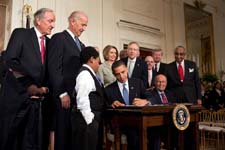
Affordable Health Care Act
Wikileaks
U.S. Supreme Court Blocks Ban on Corporate Political Funding
Chile Mine Rescue
Eyjafjallajokull Volcanic Eruption
Colocation
Flash Crash
Dodd-Frank Act
In July, Congress passed the Dodd-Frank Wall Street Reform and Consumer Protection Act in response to the financial crisis that began in 2008. It granted the federal government new authority to seize and wind down large troubled financial firms, established a council of federal regulators to monitor threats to the financial system, and mandated oversight of the derivatives market. It also gave the PCAOB authority to oversee the auditors of SEC-registered securities broker-dealers. In addition, it permanently exempted non-accelerated filers (more than 5,500 small public companies) from Section 404(b) of the Sarbanes-Oxley Act, requiring an independent auditor to attest to management’s assessment of the effectiveness of the company’s internal control over financial reporting. Dodd-Frank also gave the Commission oversight of hedge funds, private funds, and municipal securities advisers.
Consumer Financial Protection Bureau
The Dodd-Frank Act established the Consumer Financial Protection Bureau to create and enforce new rules governing mortgages and other financial products. President Obama appointed Elizabeth Warren, a Harvard Law School professor with a long track record in consumer advocacy, as a special adviser to set up the bureau; Warren later was elected to the U.S. Senate from Massachusetts. The CFPB offically began its work in July 2011, with Richard Cordray, a former Ohio attorney general, as its first director. In 2016, the U.S. Court of Appeals for the District of Columbia found the CFPB structure unconstitutional, and ordered that the bureau be restructured in line with other independent agencies; the CFPB challenged the ruling.
Financial Stability Oversight Council
SEC Bolsters Municipal Regulation
Money Market Fund Rules
Muni Council
With encouragement from the Municipal Securities Rulemaking Board, municipal bond market participants formed the Muni Council to address industry problems, especially in improving secondary market disclosure.

Occupy Wall Street
Deaths of Bin Laden and Gaddafi
Arab Spring Movement
Proxy-Access Rule Denied
SEC Appeal of Judicial Ruling
Financial Crisis Inquiry Report
Say-on-Pay Regulation

Syrian Civil War
JOBS Act
Congress passed the Jumpstart Our Business Startups (JOBS) Act, permitting emerging growth companies to raise capital through initial public stock offerings and crowd funding – using social media to reach large numbers of potential investors – exempt from U.S. Securities and Exchange Commission disclosure regulations.
STOCK Act
The Stop Trading on Congressional Knowledge (STOCK) Act was approved after a 60 Minutes report that some members of Congress allegedly used insider trading information for personal gain.
National Exam Program
In the wake of the Commission’s failure to expose the Madoff and Stanford Ponzi schemes, new OCIE Director Carlo di Florio, working closely with regional and national staff, implemented the National Examination Program. The NEP was intended to strengthen the examination process by recruiting specialists in critical risk areas and streamlining processes, particularly by partially automating examinations. Di Florio sought to emphasize that despite regional differences the SEC examination program was consistent nationwide.
Private Equity and Presence Exams
Dodd-Frank had assigned the Commission oversight of private equity funds, with which the SEC had little experience. In October, OCIE implemented a program of risk-based, focused, private equity adviser “presence exams” intended to establish SEC authority and gather information. The initiative identified significant problems in private fund expenses, hidden fees, and market valuation.

Boston Marathon Bombings
Pope Benedict Retires – Pope Francis Elected
National Security Agency Surveillance
MIDAS
The SEC Market Information Data Analytics System went on line, providing regulators with a billion records a day from the proprietary feeds of each equity exchange. The step was considered crucial in regulating increasingly fast and complex markets.
Volcker Rule
Broken Windows Enforcement Strategy
The U.S. Securities and Exchange Commission adopted a “broken-windows” approach in enforcement, modeled on a theory of community policing targeting small problems in an effort to fight crime. The SEC pursued both small legal violations and more serious fraud to foster a culture of compliance.
Dark Pools Disclosure
Exchange Mergers

Janet Yellen First Woman Chairman of Federal Reserve
U.S. Resumes Diplomatic Relations with Cuba
Ebola Virus
Islamic State of Iraq and Syria
Reg SCI
Bitcoin Regulation
Supreme Court Rules for Stanford Investors
New Rules for Money Funds
National Stock Exchange
Impact of Real Time Reporting in Municipal Market
In its study of secondary market trading in the municipal securities market, the Municipal Securities Rulemaking Board confirmed that price differentials decreased with the introduction of real time reporting.
Insider Trading Liability Limited
In U.S. v. Newman, the Second U.S. Circuit Court of Appeals limited tippee insider trading liability, finding that an insider breached fiduciary duty only when disclosing inside information in exchange for personal benefit, and that the tippee knew of such benefit.
Treasury Bond Flash Crash

Supreme Court Affirms Same-Sex Marriage
Black Lives Matter
European Refugee Crisis
China Abandons One-Child Policy
Bitcoin Exchange
ETF Flash Crash

Donald Trump is sworn in as President.
Kokesh v. SEC
In a decision resulting from a 2009 case against an investment manager, the Supreme Court deals a blow to the Commission, holding disgorgement subject to a 5-year statute of limitations since it is punitive rather than compensatory. The decision has the potential to undercut SEC leverage in settlements and cause the Commission to bring cases more quickly than usual.
Retail Strategy Task Force
Fixed Income Market Structure Advisory Committee
SEC deems Cryptocurrency a Security

The United States begins a trade war with China.
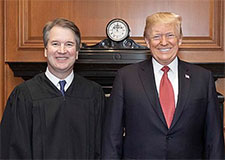
The Senate confirms Brett Kavanaugh’s nomination to the Supreme Court.
“Notice and Access” via Internet
Extending Scaled Disclosure
In July, the Commission expands the definition of a “smaller reporting company” from $100 million to $250 million. This rule change is intended to allow more companies to use “scaled disclosure requirements” available as a result of the 2012 JOBS Act.
Tesla Twitter Charges

The yield curve inverts and the Dow drops 500 points the next day.
The Coronavirus pandemic begins in Wuhan, China.
The House impeaches President Trump.
Lorenzo v. SEC
This landmark Supreme Court decision holds that a person can be liable under 10(b) anti-fraud provisions even if he or she did not make the fraudulent statement in question. Lorenzo essentially reverses the more restrictive 2011 Janus Capital Group v. First Derivative Trusts decision and wipes out a common defense used by fraudsters.
Courts Deem Cryptocurrency A Security
Following the lead of the SEC and the 2nd Circuit Court, the Southern District of New York, in the Balestra v. ATBCoin LLC decision, subjects cryptocurrency to the Howey test and deems it to be a security.
Facebook Settlement
ETF Rule
Insider trading “Personal Benefit Test” overturned
Upending years of precedent going back to the Dirks decision, the 2nd Circuit Court in the US v. Blazczak decision expands the definition of insider trading, holding that inside traders need not benefit personally from the fraud. This greatly widens the latitude to bring insider trading cases.