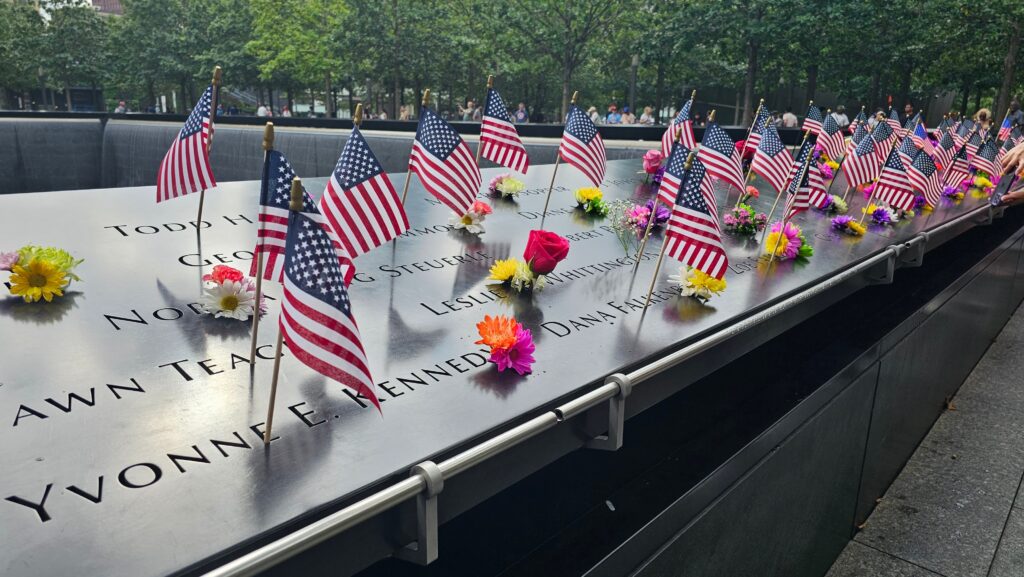
Twenty-five years after the 9/11 attacks, the SEC Historical Society invites you to remember, reflect, and learn from the oral histories, conversations, and remembrances in our virtual museum archives.
Overview
The September 11 attacks had their most direct impact on the SEC’s infrastructure through the devastation of its New York Regional Office (NYRO). As the SEC’s largest regional office, the NYRO occupied three floors at 7 World Trade Center, housing 320 Enforcement and Examination staff. Following the collapse of the Twin Towers, the office was evacuated without any loss of life. Later that day, the building itself collapsed, destroying all contents. Demonstrating remarkable resilience and decisive leadership, the SEC quickly secured new offices in lower Manhattan’s historic Woolworth Building and returned its staff to work. Within weeks, the NYRO had resumed full operations.
SEC Firsthand Accounts of 9/11
Robert Sollazzo
On the morning of September 11, 2001, Robert Sollazzo looked out his window at the SEC Northeast Regional Office in 7 World Trade Center and saw the first plane hit. Sollazzo, head of the broker-dealer examination program, initially thought it was a bus coming off the side of the building. But when everything shook and rattled, he and the staff realized, “there’s something wrong here.”
In his February 24, 2023, oral history, Sollazzo vividly describes how everyone ran to the center of the office, walked down the stairs, and out the back door as debris fell, unsure if their building would also fall. Later that day, Sollazzo was charged with reaching all the examiners who worked in the Towers, and he had accounted for all of them except one.
“This was the last call I made, and she was working in, I think, the 45th floor of the North Tower, and when she picked up the phone, it was such a sigh of relief that she was okay…. Her name was Lourdes (Caballes),” Sollazzo said. He later learned that she had to run down the stairs and was exiting the building as it collapsed. “She was covered with a powder, and she was the most well-adjusted person you could ever meet; it’s amazing. She was ready to go back and do an exam the next day.”
Robert’s recollection of this event occurs at the 56:24 mark of his oral history video and starts on p. 17 of the transcript.
Listen to Robert Sollazzo’s oral history →
Harvey Pitt
Harvey Pitt became the new SEC Chairman just weeks before the attacks. In his May 12, 2008, oral history, he said that he was set to be sworn in at the SEC on September 17 in the White House, but that never happened.
“In your wildest dreams, you could not have envisioned something like that—it’s not just the terribleness of the terrorist attacks, but that it would threaten our whole capital market system was—that is not what one thinks about as the issues I’m going to go to work today and face. It just couldn’t have been further from my contemplation.”
Pitt, his deputy chief of staff, Lisa Panasiti, and his chief of staff, Mark Radke, went into crisis mode when they heard the second plane crashed. He describes what he did that day; his first and last phone calls were to Richard Grasso, chairman and chief executive of the New York Stock Exchange.
“My biggest fear, which didn’t get allayed until September 17th, was if we got the markets back up and running, would they collapse again?” said Pitt.
This is a compelling oral history; he starts talking about 9/11 at the 01:02:45 mark on the recording, and on page 12 of the Harvey Pitt, Part 2 oral history.
Listen to Harvey Pitt’s oral history →
Paul Roye
Paul Roye was Director of the Division of Investment Management in the SEC’s Washington office that day. In his oral history, he recalls the attacks as a crucial test of the agency’s ability to turn preparedness into decisive action. He credits SEC Chairman Harvey Pitt with calm, coordinated leadership that helped stabilize the SEC and broader financial markets.
“I just remember that day in Washington and all the panic…. And then, of course, the New York Stock Exchange shuts down, and Harvey Pitt pulled everybody together, pulled all the heads of the major firms together, and got everything up and running. We took emergency actions that people probably don’t remember,” said Roye. One action he mentions is emergency Investment Company Act Relief issued because nobody would fly; fund boards could not hold the in-person meetings the Act requires.
Learn more from Paul Roye starting on page 45 of his June 21, 2016, oral history or at 01:42:07 of the recording.
Listen to Paul Roye’s oral history →
September 11 – 20 Years Later: A Lesson in Crisis Leadership (video)
This September 20, 2021, Conversation brought together Wayne Carlin, Roger Ferguson, Jr., Annette Nazareth, Harvey Pitt, and David Becker as moderator. The panel examined the immediate aftermath of September 11, 2001, for the U.S. financial system. The collapse of 7 World Trade Center destroyed the SEC’s New York office; communications and infrastructure around Wall Street were severely disrupted, and financial markets closed. Despite these challenges, the financial system reopened on September 17—just six days after the attacks—without the chaos or loss of confidence many had feared.
Related Archives
- David Becker Oral History, May 21, 2015; General Counsel 2000–2002
- Wayne M. Carlin Oral History, September 10, 2021; Regional Director, Northeast Regional Office, 2000–2004
- Jill Considine Oral History, August 1, 2021; Chairman and CEO, Depository Trust & Clearing Corporation, 1999–2006
- William Johnston Oral History, May 10, 2010; President and Chief Operating Officer, New York Stock Exchange, 1996–2001
- David Doherty Oral History, April 8, 2010; Executive Vice President, Enforcement, New York Stock Exchange
- 2005 Annual Meeting: “Crisis and Resolve: The SEC and the Securities Industry Remember September 11, 2001.” (video)
- Remembrance of Stuart J. Kaswell, May 27, 2005
- Remembrance of Bret Johnson, May 17, 2005
- Remembrance of Sean Kemple, April 18, 2005