
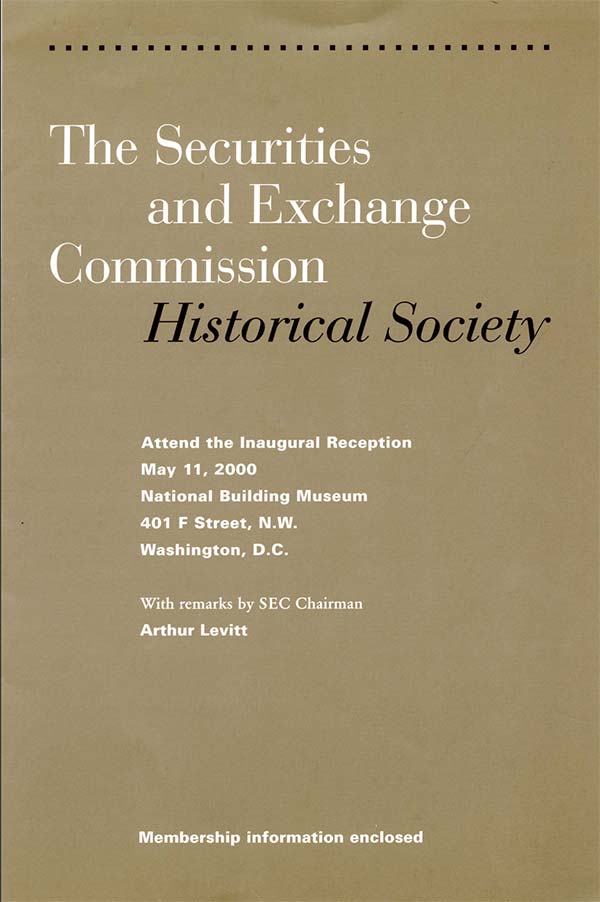

A proposal for a SEC Historical Society is put forward by Gregg W. Corso (SEC staff) and others, and recommends that former SEC Chairman David Ruder lead the effort.


The SEC Historical Society’s founding Trustees — David Ruder, Harvey Pitt and Paul Gonson — pose at the National Building Museum with then-SEC Chairman Arthur Levitt at the May 11, 2000 inaugural reception. [9112]

Professor David S. Ruder delivers remarks at the May 11 reception and describes his vision for the SEC Historical Society. [9062]
A list of attendees of the inaugural event reveals interest by SEC staff and that of other regulatory and regulated entities, the securities bar, individuals from academia, and those from the accounting and auditing profession. [9063]

On August 30, 2000, David Ruder writes Professor Joel Seligman to thank him for agreeing to chair the Society’s Acquisitions Committee. In the letter, he also indicates additional priorities: recruiting a full-time Executive Director and activating volunteer Trustees of the Board to perform certain tasks until staff is hired. [9051]

On March 19, 2001, Carla Rosati is hired as the Society’s first Executive Director, a position she held through May 2017.


On August 3, 2001, Harvey Pitt is appointed Chairman of the US Securities and Exchange Commission and resigns as President of the Society. Paul Gonson becomes Society President and Robert Kueppers Secretary-Treasurer. David Ruder remains Chairman.

While the Society is planning major new “firsts” for the autumn of 2001 to showcase itself and its mission, horrific national news will soon break — including the September 11 terrorist attacks and an anthrax letter scare – and consume the attention of the general public and coincide with an already slowing economy.
Two days after the September 11 attacks, the Society conducts its first oral history interview with Milton Kroll on September 13, 2001. [KROLL OH]


The following month, on November 14-15, a joint SEC Historical Society and U.S. Securities and Exchange Commission major issues conference, “Securities Regulation in the Global Internet Economy,” has been months in the planning with the support of Northwestern University School of Law.
Aimed at showcasing the Society, those invited would include representatives of the world’s major securities regulators, U.S. and foreign securities exchanges, major investment banks, academics and lawyers. [9066]


While deemed a substantive success, the November 2001 major issues conference was not a financial one, leaving the Society with over $100,000 in debt. Northwestern University Law School came to the Society’s rescue and absorbed the liability. The Society agreed to pay $50,000 back to Northwestern in 2 installments in 2002.


On May 11, at the Board’s annual meeting, eleven Trustees formally decide to continue efforts to sustain and grow the Society and virtual museum. David Ruder remains Chairman; Theodore Levine succeeds Paul Gonson as President; Robert Kueppers continues as Treasurer; and Stanley Keller becomes Secretary.


