
Given the SEC’s chronic lack of funding, federal regulators required capable partners to establish an effective inspection regime. In the early 1950s, when Congress defunded the inspection program, the Commission turned to the states and the NASD for help, only to find that neither was up to it. And in regulating investment companies, advisers, and unaffiliated broker-dealers, the SEC had no partners at all.
Inspections in Spare Times
Helped along by a Republican Congress, SEC appropriations began trending downward in the early 1950s and inspections per year dropped from more than 1,000 in the late 1940s to about 700 in 1953.(7) Chairman Ralph Demmler warned legislators that “many members of the public think that brokers and dealers are examined with the same regularity as banks. This is not true and unless the Commission had a vastly increased budget it could not be true.”(8)
Conservative legislators preferred to leave inspection to the states. In 1954 therefore, Demmler introduced the “Cooperative Inspection Program,” in which state regulators, the NASD, the exchanges, and the SEC would share the burden equally. The regional administrators poured cold water over Demmler’s plan. Atlanta Regional Administrator William Green pointed out that no southern state could conduct anything close to one-third of the required broker-dealer inspections. Few northeastern states could do so either.(9)
The NASD inspection program was only slightly less problematic. It still relied heavily on volunteers.(10) In addition, since the SEC focused on risk and records, and the NASD on member qualifications, pricing, and sales practices, the two inspection programs were not interchangeable. In 1955, Chair J. Sinclair Armstrong extracted new appropriations from the now-Democratic Congress on grounds that “regular and periodic inspection of broker-dealer firms is a vital part of the Commission’s enforcement program.”(11)
Investment Companies and Advisers
Meanwhile two pieces of legislation with the potential to reshape the inspection program lay dormant. Section 31 of the Investment Company Act of 1940 enabled the SEC to require recordkeeping and to conduct “reasonable periodic, special, and other examination” of investment companies. In 1940, however, most investment companies were closed-end trusts suitable only for seasoned investors, so there seemed to be little need for Commission attention.
That changed in 1956 when the SEC examined the books of one particular company and was disturbed by what it saw, particularly in light of the fact that total investment company assets had grown more than fivefold since 1941, with most of the growth in open-ended funds aimed at the general public. The investment company inspection obligation was then minimal compared to the broker dealer burden, but Title II of the 1940 legislation, the Investment Advisers Act, eventually overwhelmed the SEC’s inspection capacity.
In 1940 the Commission knew little about investment advisers. There were a few periodic reporting services and a few hundred specialists serving mostly wealthy clients required only to submit annual reports. In 1945 there were 780 advisers registered with the SEC. Fifteen years later there were more than twice that many, and the industry, as one scholar put it, “had shown little capability for self-regulation.”(12) As a result Congress passed the 1960 Amendments to the Investment Advisers Act, Section 204 of which required advisers to keep books and to allow the SEC to inspect them.
The SECO Experiment
Meanwhile, the Commission’s 1963 Special Study of the Securities Markets had drawn attention to the fact that broker-dealers unaffiliated with the NASD were not being examined at all. The SEC suggested requiring the holdouts to join the NASD; Congress directed the SEC to provide them with an equivalent level of inspection instead.
The SEC spent much of 1965 figuring out how to replicate the NASD member regulation program. By mid-1966 a new Branch of Non-NASD Regulation was conducting examinations. By 1968 the program was called SECO, for “SEC Only.” The SECO program was expensive, time-consuming, and in some respects an unfair imposition by legislators who consistently underfunded inspections and then complained about them. SECO was terminated at the end of 1983 by SEC request.
SECO had not been all bad. Robert Sollazzo started at the New York Regional Office as a broker dealer examiner, later rising to Associate Regional Director for broker-dealer exams. He recalled that in SECO examinations, which tended to be comprehensive and involve small firms, “you really [got] an understanding of how the industry worked. Clearance and settlement process, custody, the net capital rule.”(13) But the demands of SECO left few resources available to monitor NASD-affiliated and exchange member firms. In some regional offices, therefore, the unofficial rule was to focus primarily on SECO and cause exams.(14)
Crisis and Consequences
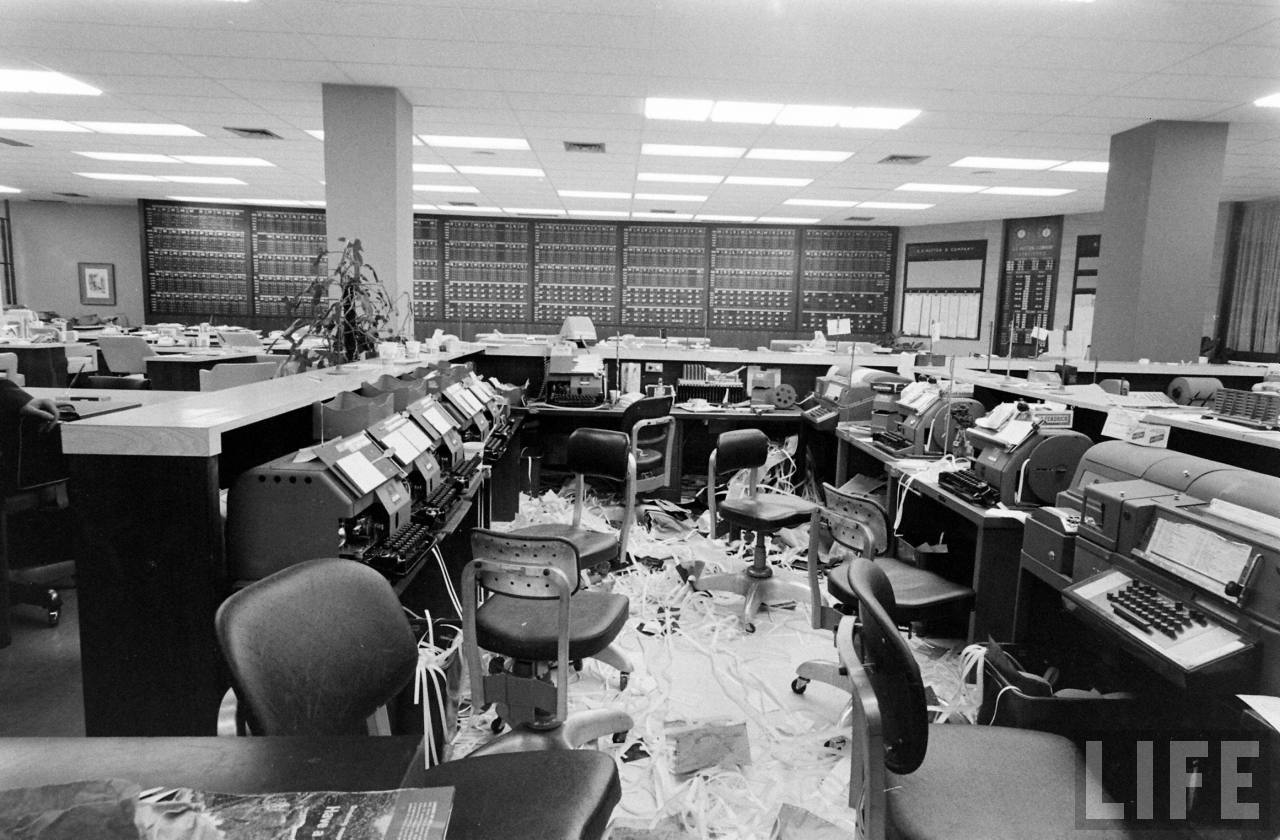
The 1960s was a good decade for exchange member firms. Some merely pocketed the profits brought in by the boom; others rented expensive space or bought computers they did not learn to use. As volume exceeded capacity, brokerage back offices began to report “fails”—lost certificates and delays in executing and settling trades. Then, in 1969, the market began to turn down and complaints about broker-dealers tripled. At that point, the New York Regional Office had only ten examiners to cover 2,000 member firms and review 1,700 SECO reports.
The Commission and the NASD both redeployed inspectors to help straighten out this “back-office crisis,” but a wave of broker bankruptcies nevertheless followed the market downturn. The crisis led to notable reforms. New legislation created the Securities Investor Protection Corporation (SIPC) and provided a supplemental appropriation so that the SEC could “undertake a rapid and significant expansion of its broker-dealer inspection operations.”(15)
In January 1972, Chair William Casey created the Office of Broker-Dealer and Investment Adviser Examinations in the Division of Trading and Markets, bringing all Commission inspection programs briefly together in one entity. That August, however, as part of a reorganization of the entire SEC recommended by the Wells Commission, the investment company and investment adviser examination programs were transferred to a new Division of Investment Management.