
By the 1970s the term “inspection” was giving way to the word “examination” within the SEC. In the 1930s inspectors, usually accountants, had used the term “audit.” The SEC chief accountant recommended using the less confrontational term “financial examinations” instead.(16) Although the term inspection won out for a time, “examination” came back in the 1970s, likely due to its less confrontational connotations and because NASD inspections were often called examinations since they included an actual test. New terminology was warranted since the back-office crisis had caused a complete rethink of the program. Meanwhile Congress added to the entities coming under SEC purview, and the Investment Adviser program, once an afterthought, began to overwhelm the agency.
The 1975 Acts Amendments
The reinvention of the inspection regime began with passage of the 1970 Securities Investor Protection Act which made any given broker-dealer accountable to only one SRO. In 1971 the SEC raised broker-dealer minimum net capital requirements in Rule 15c3-1. In 1972 the SEC adopted Rule 15c3-3, the Customer Protection Rule, to ensure that a failed broker could satisfy its claimants. The 1975 Securities Acts Amendments amended 15c3-1, creating the Uniform Net Capital Rule to eliminate confusion over net capital requirements which had exacerbated the back-office crisis.
The 1975 Acts Amendments also required the SEC (or an SRO) to examine every new broker-dealer within six months of registration and added municipal securities dealers, transfer agents, and clearing agencies to the list of entities the SEC had to examine. During the next decade, options exchanges, and government securities dealers added to the burden.
In exchange for new responsibilities the 1975 Acts Amendments gave SEC examiners wider latitude than before. Previously, inspection authority was limited to required books and records. The 1975 Act Amendments allowed examiners of broker-dealers and investment advisers (although not investment companies) to look beyond these records. Henceforth, the SEC held that its authority was “unconditional except for the requirement that any such record examination be ‘reasonable’.”(17)
Broker-Dealer Oversight
A decade earlier, citing duplication between SEC and NASD efforts, the ‘Special Study of Securities Markets’ had recommended improvement of the NASD program “to the point where the Commission would have full confidence in its thoroughness, so that the Commission could devote more of its resources to special problems disclosed by NASD inspection and to general oversight of the working of the inspection and other self-regulatory programs.”(18)
The groundwork for this new program was laid in fiscal year 1964 when personnel from the home office began inspecting NASD national and district offices. Examiners looked at district committee systems and staffing, reviewed relations with SEC regional offices and other SROs, tracked the effectiveness of disciplinary action, and evaluated new and existing rules.
Over time, the SEC developed a two-part oversight inspection program. First, a team from the Division of Market Regulation evaluated the NASD’s review of particular broker-dealers. Next, SEC personnel conducted their own examinations of the same broker-dealers and compared those results with the NASD findings. The back-office crisis made confirming the financial soundness of broker-dealers top priority for examiners. Key to this “early warning system” were new requirements that for broker-dealers to submit monthly financial reports and the 1971 Notification Rule, Rule 17a-11, requiring broker-dealers to inform the SEC and the SROs when they exceeded “certain specified financial or operational parameters.”
In 1979, after a General Accounting Office review, the Commission reorganized the oversight program to gain more frequent and substantial information from the SROs. During the early 1980s, the home office steadily pushed responsibility for the oversight examination program down to the regional staff.
Checklists, Computers, and Training
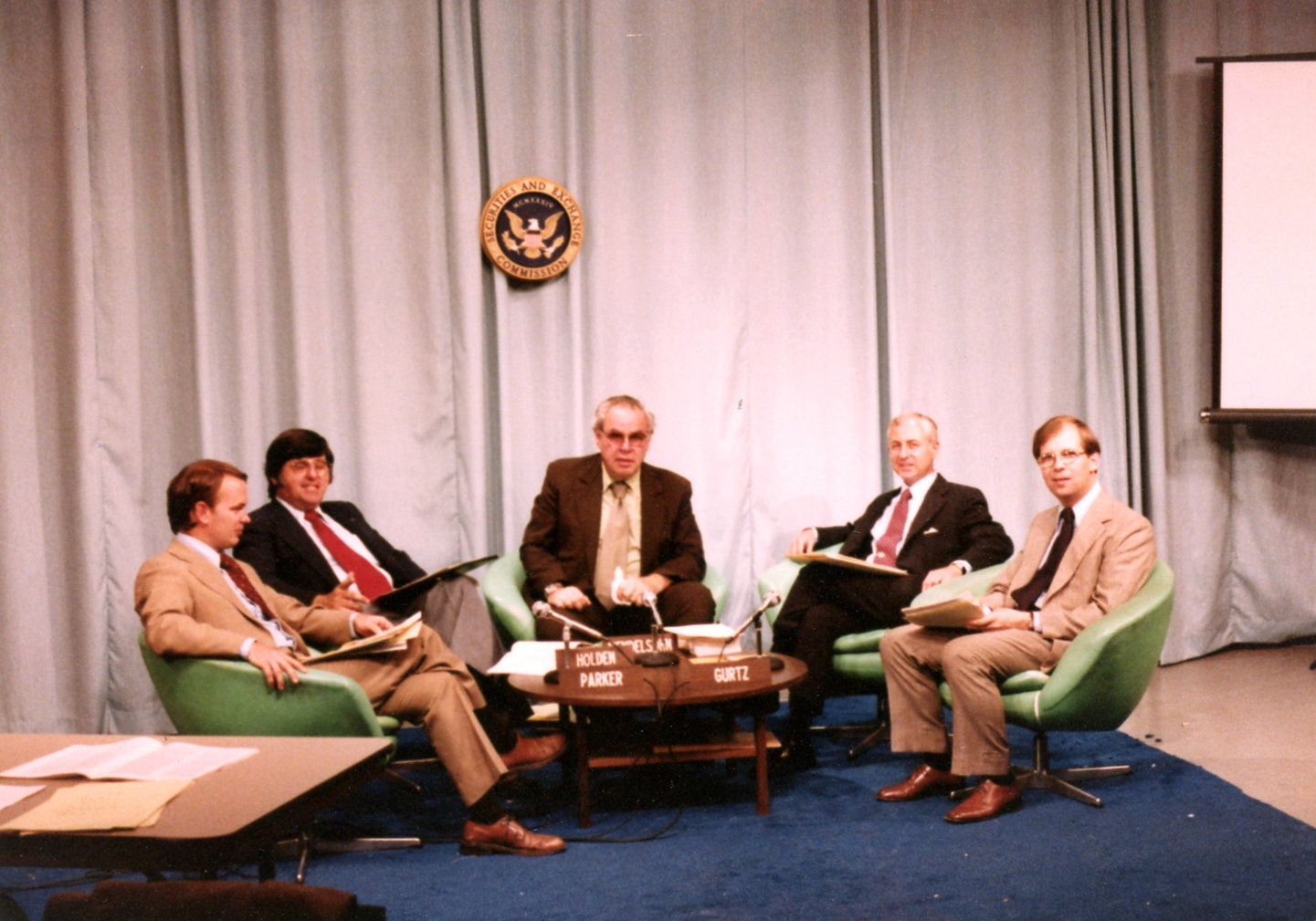
As the Divisions of Trading and Markets and Investment Management updated their exam programs in the 1970s, they used documents and digital resources to promote consistency. The Division of Trading and Markets regularly updated its broker-dealer examination manual and periodically introduced new examination checklists. The Division of Investment Management developed its own examination manual and produced a videotaped “compliance course” for distribution to the regions.(19) Most effective at driving consistency was the Financial and Operational Combined Uniform Single (FOCUS) report, introduced in 1976, which market participants were required to submit to federal, state, and self-regulatory authorities.
The SEC also worked to harness information technology. By 1973 an automated system to coordinate broker dealer exams conducted by the SEC and other entities was operational. By far the biggest technological challenge was the system built at the behest of Congressman John Moss, which developers dubbed the Market Oversight and Surveillance System (MOSS). Ahead of its time, MOSS never lived up to expectations.
When computerization first made a big difference in the exam program it was on a more modest basis. In fiscal year 1988 the Commission began providing laptops for examiners.(20) Gene Gohlke, who was in the Division of Market Regulation Investment Adviser/Investment Company (IA/IC) program recalled that internal manuals and exam findings were computerized fairly quickly. Examiners also began accessing and storing computerized data around this time.(21)
Pushing the Boundaries
By the 1980s, investment advisers posed a perplexing problem. The broker-dealer model had once been the industry standard. Now, the investment adviser model was overtaking it, driven by increased availability of retirement funds and the fact that compensation for assets under management rather than by trades provided financial professionals with a steadier stream of income.
In the year 1983 alone, the number of registered investment advisers increased by 34 percent with no commensurate increase in SEC funding. The solution to broker-dealer growth, reducing cyclical exams and relying on oversight exams, was not available since investment advisers had no SRO. The Commission considered both the formation of a new SRO for the IA/IC sector and the prospect of requiring investment advisers to hire private sector examiners. But industry opposition stalled both proposals.
In the early 1990s, the Division of Investment Management relaxed cyclical supervision of smaller advisers to focus primarily on large firm exams, putting advisers managing at least $1 billion on a three-year cycle. But diverting resources was not a long-term fix, so Chairman Richard Breeden mounted a Congressional campaign, insisting that “the public is led to believe that advisers are under SEC oversight, when in fact in most cases we will not provide any effective inspection or oversight unless we obtain special knowledge that a problem may exist.”(22)
Then, in 1994, a pair of economists discovered that NASD broker-dealers had been illegally increasing their spreads by trading only in odd-eighths. Both NASD and SEC examiners had missed it, and their legislative overseers were unhappy. As the mid-1990s approached, the SEC’s entire examination program was under a great deal of strain.