
OCIE entered its second decade having brought more uniformity of focus to the entire examination program. OCIE leaders built on this foundation by becoming public champions of a culture of compliance. This heightened visibility, however, left OCIE exposed after the economy crashed and previously undetected non-compliers harmed investors and imperiled the Commission.
Sweeps, Publicity, and Pushback
Near the start of her tenure at OCIE, Lori Richards had been surprised to find that the press was interested in examinations—she resolved to use her influence to enlist market participants in building a compliance culture.(41) Other OCIE leaders also spoke publicly, their statements appreciated by industry participants long accustomed to silence about what inspectors were finding behind the closed doors of non-public examinations.
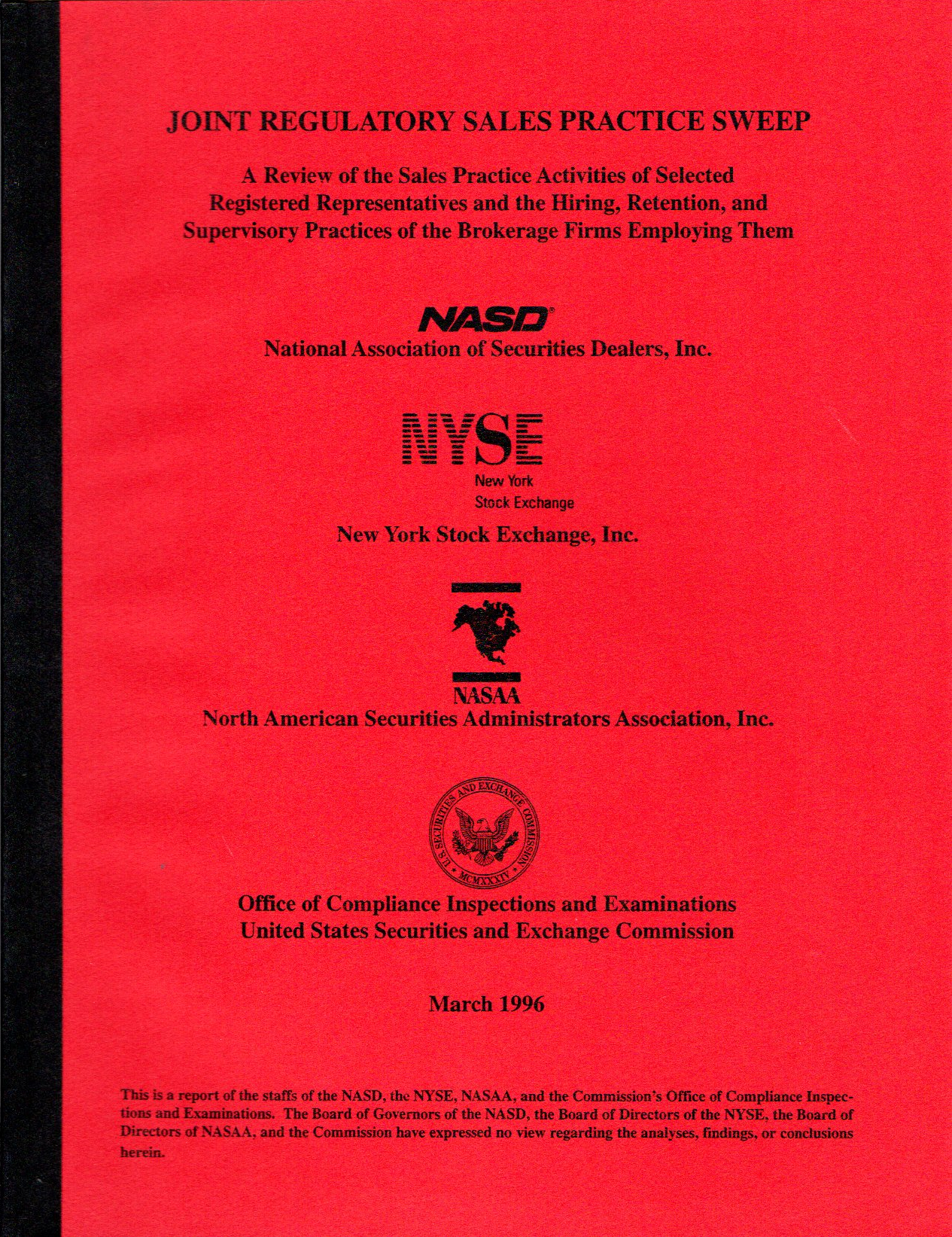
Equally effective in calling attention to emerging issues were sweep examinations into on-line trading in 2001, and the growth of hedge funds in 2003. In all, OCIE conducted dozens of sweeps during this period, with the regional offices engaged in conceptualizing and conducting the efforts. OCIE also provided the Commission and staff in the divisions with non-public sweep reports, fulfilling its duty to act as the SEC’s “eyes and ears.”
By the 2000s OCIE was insistently setting forth what it believed to be “best practices” for industry firms in public reports, articles and speeches. OCIE viewed the reports to be a way to set much-needed industry standards. Although some within the Commission considered this to be policymaking, the staff considered this to be the responsibility of the divisions.
Outside the SEC, contention continued over the appropriate relationship between OCIE and the Division of Enforcement. Referrals to the Division of Enforcement provided strong messaging and served as a deterrent. After referring a matter, examiners often then worked closely with enforcement lawyers to bring the case. Examiners and enforcers learned that they had much in common, but to outsiders this cooperation raised concerns commensurate to those raised by the sweep program. “The sweep initiative was something that folks could latch onto,” said John Walsh, “and people really pushed back.”(42) Those who pushed back included not only firms and industry groups but also the occasional commissioner who believed that OCIE was unduly burdening registrants.
It was during this time that email became pervasive, and while these communications provided critical evidence of motivations, intentions, and conflicts of interest often cited in exam reports, this new level of scrutiny elicited indignation from industry participants who found an advocate in Staten Island Congressman Vito Fosella. In 2006, Fosella introduced a bill in Congress disbanding OCIE. The bill did not advance, and by the mid-2000s, thanks in large part to OCIE, everyone had to be concerned with compliance.
Compliance and Culture
One of the most damning revelations from the late trading and market timing scandal was that senior fund industry executives had been fully aware of the practice. Rule 38a-1, the SEC Compliance Rule, adopted in December 2003, therefore sought to create a countervailing power, a new advocate for compliance within each fund and adviser. The rule required firms to adopt written policies and procedures designed to prevent securities law violations, to conduct an annual review of that compliance program, and to hire a chief compliance officer (CCO) to administer those policies.
By creating an organizational compliance obligation, the SEC hoped to compel firms to allocate more resources to compliance than they had formerly. OCIE further sought to promote increased professionalism among chief compliance officers and to create an ally in the compliance crusade within every investment company and adviser.(43) OCIE fostered this new relationship by creating the CCOutreach Program in 2005, which included national and regional seminars and publishing ComplianceAlerts, providing regular notice of emerging trends, concerns, and best practices, beginning in 2007.
Compliance was not just for the IA/IC sector. By 2004, OCIE was also conducting comprehensive compliance and internal controls examinations of broker-dealers. By 2008, OCIE offered a broker-dealer version of CCOutreach, providing regional seminars along with the NASD, recently renamed the Financial Industry Regulatory Authority (FINRA).
Chair Donaldson had championed “establishing a culture where the highest standards of behavior are practiced.”(44) During her tenure, OCIE Director Richards regularly advocated building up a culture of compliance.(45) Meanwhile professional compliance officers in each firm amplified the message many times over. Noncompliance became all too tempting, however, as the nation entered the Great Recession.
The Great Recession and After
The bursting of the housing bubble raised questions about the easy flow of credit, many of them answered in OCIE’s last public sweep report on conflicts of interest within credit rating agencies. But as the recession deepened, corporate compliance suffered, and OCIE staffing decreased by more than ten percent. “The public expected that examiners would be in there looking more regularly than we were able to,” Richards noted, “and there was a gap between their expectations and what we could do.”(46)
A quarter century of rapid change in the financial industry, noted scholar Arthur Laby, had “blurred the lines between brokers and advisers.”(47) Bernard L. Madoff Investment Securities had been a broker-dealer and third market maker for years. The SEC’s home office and Northeast Regional Office staff had examined those activities in 1992, 2004, and 2005. Madoff registered as an investment adviser in 2006, but no one at OCIE had examined that part of the firm. In December 2008, Madoff confessed to conducting the largest Ponzi scheme in history through his investment adviser. A month later, the Fort Worth Regional office belatedly exposed the Allen Stanford Ponzi scheme, more than a decade old.
OCIE immediately began remedying problems, but pressure on OCIE and the Division of Enforcement was unrelenting. At a February 2009 hearing, Congressman Paul Kanjorski threatened to do away with the SEC entirely. Three problems emerged from Congressional hearings and the SEC Inspector General’s investigation that followed. First, staff on the Madoff examinations lacked the expertise required to detect complex fraud. Second, examiners had failed to verify assets. Third, the SEC’s divisions, offices, and regions did not adequately share information. In September 2009, the Inspector General made 37 recommendations for improving SEC enforcement and examinations. Chair Mary Schapiro agreed with all of them.
By then, OCIE had made a few significant changes under acting director John Walsh. Senator Christopher Dodd had recommended that “the SEC should hire staff with real world experience.”(48) Walsh implemented the Senior Specialized Examiner program to recruit industry veterans with experience in complex financial valuation, trading, and accounting. Walsh also instituted an asset verification protocol and arranged for examiners to gain third-party fraud examiner certification.
Lori Richards had taken fragmented examination programs and in what she called a “14-year process of driving consistency, and driving consensus,” built a more unified program based on compliance.(49) At the end of the compliance period examiners were more assertive, influential, and had better tools, but the historic mismatch between the scope of the regulatory task and the resources allocated to the exam program remained. With hard-learned lessons in mind and with the prospect of increased funding ahead, OCIE prepared for a post-Madoff world.