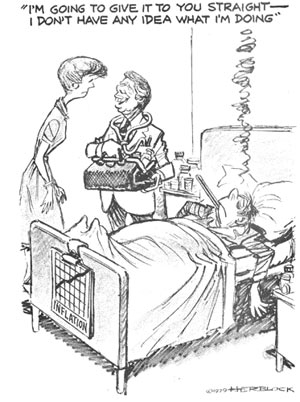
– April 27, 1979 “I’m Going to Give It To You Straight – I Don’t Have Any Idea What I’m Doing,” Herblock, Copyright by The Herb Block Foundation
Having the authority, however, did not mean that the SEC would use it. When Harold Williams became SEC Chairman, the country’s mood for revolutionary change had cooled. The economic crisis of high unemployment, high inflation and rising interest rates dampened demands for immediate change to the market system, which many believed remained economically fragile.(36)
Rejecting revolutionary change, SEC Chairman Williams took a go-slow approach, relying on SEC and industry negotiation and cooperation, balancing the political influence of the SEC against calls from Congress for mandated change. Williams believed that the SEC was ill-suited “by experience or disposition” to serve as a “planner for industry.”(37) He favored industry and market forces instead of SEC mandate to create the system. As a result, it appeared that securities industry experts were taking the lead in the design and implementation of the system.
But it was not merely the deliberate approach from the SEC that delayed implementation of the central market system. President Carter’s view of the SEC and its role as a regulator of the markets stands in sharp contrast to his other initiatives to regulate the economy. Although willing to consider price and wage controls, President Carter took a hands-off approach to the SEC.
His archives provide clues as to why he took that approach. The public worries about inflation meant that that issue would remain the single most important of his Presidency. But nearly as important was Carter’s belief that the SEC was a non-partisan agency, and that once he made his appointments, he should refrain from attempts to influence its policies. He respected the SEC and its staff and believed that the SEC and the markets could manage without his political influence and interference. After appointing Williams as SEC Chairman, Carter remained mostly neutral on SEC regulatory matters.
While this does not fully explain the deliberate approach of the SEC under Chairman Williams on the creation of a national market system, it does help explain how the momentum for change began to slow to a trickle from 1977 to 1980. By then, Congress once again was taking the lead, criticizing the agency for its inaction and lack of leadership. The danger, stated the House Subcommittee on Oversight and Investigations after studying the SEC’s role in the creation of the central market system, “is that the Commission will be led by the strongest, most persistent voices in the industry rather than by its own independent assessment of the systems and rules necessary,” leading to superficial instead of fundamental changes necessary to provide the best price most efficiently to investors.(38)
Chairman Williams had to balance those competing interests and voices inside and outside the SEC, always aware that the substantial changes being proposed could do great damage if poorly implemented.