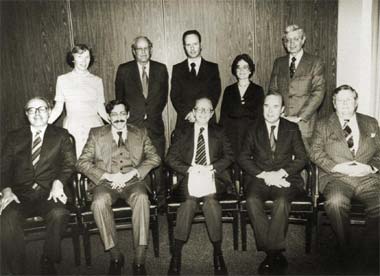
– November 1977 SEC Advisory Committee on Corporate Disclosure (standing, left to right) Mary “Mickey” Beach, Philip A. Loomis, Jr., John R. Evans, Roberta Karmel and Harold Williams; (seated) Alan Levenson, (unknown), A.A. Sommer, Jr., (unknown) and John “Sandy” Burton
In early 1976, Congress reviewed three significant pieces of legislation. On March 11, Senator Proxmire warned that, if left unchecked, “it will be only a matter of time before these same corrupt practices inflict our domestic economic system.” His S. 3133 made it illegal to bribe foreign officials, required disclosure of foreign sales agents and their commissions, and mandated strict record-keeping.
On May 5, Senator Frank Church (D-Idaho) proposed S. 3379, requiring the SEC to collect information on payments and the State Department to review the practice. It also required corporations to maintain an independent audit committee, ensured shareholders the right of legal action in case of a payments scandal, and encouraged the President to forge international agreements regarding the bribes. (20)
These bills established two different approaches to solving the problem of corrupt payments: criminalization or disclosure. At the time, it was not illegal for U.S. citizens to bribe people abroad. Those who wanted to make it so supported Proxmire’s measure, arguing it would deter the practice. Others believed that this was unenforceable and that disclosure of the source and recipient of payments would be enough to deter companies from making them; Church spoke for these. In the Senate, criminalization prevailed and the Proxmire bill became the main vehicle for anti-bribery legislation.
The third major proposal came out of the SEC’s investigation. By 1976, the SEC was looking at thirty different companies and another fifteen had confessed to making questionable payments. (21) The SEC instituted a voluntary disclosure program, allowing companies to turn themselves in, self-investigate, accept tighter controls and usually escape prosecution. By May, the SEC had received information from approximately one hundred companies and concluded that there was no “inherent defect in our economic system.”
SEC Chairman Roderick Hills believed that the problem was best corrected “with the tools we now have” rather than new legislation, although he conceded that a law punishing false record-keeping might be in order. The SEC investigation, the results of which were submitted to the Senate Banking Committee on May 12 along with legislative recommendations, bore this out, finding an “almost universal” failure of the system of corporate accountability, with falsified records common knowledge to senior staff but “concealed from outside auditors and counsel and outside directors.”
The SEC’s legislative recommendations sought to bolster corporate governance. Rather than criminalize bribery abroad, the SEC proposed to prohibit falsifying corporate records, prevent corporate officials from misleading auditors and require internal accounting controls. Senator Proxmire worked with the SEC to propose S. 3418, combining the SEC’s proposals with his criminalization bill, which he believed would easily pass that session.
As the SEC and Congress refined their bills, the White House weighed in. President Ford placed Commerce Secretary Elliot Richardson at the head of the Task Force on Questionable Corporate Payments Abroad and directed him to “conduct a sweeping policy review…and to recommend such additional policy steps as may be warranted.”
The Task Force came down in favor of disclosure. Richardson believed that criminalization and disclosure would work at cross purposes, and because enforcing criminalization would be “very difficult if not impossible,” he considered systematic disclosure the best response. By August, the Task Force had prepared draft disclosure and corporate accountability legislation. It made the Executive branch responsible for disclosure and punished non-disclosed violations with a $100,000 fine, while imposing criminal penalties on willful violators. Congress could now choose between three distinct plans for confronting the payments scandal: those of the SEC, the Senate, and the Administration.