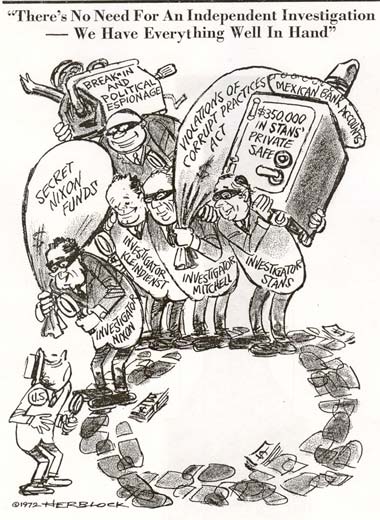
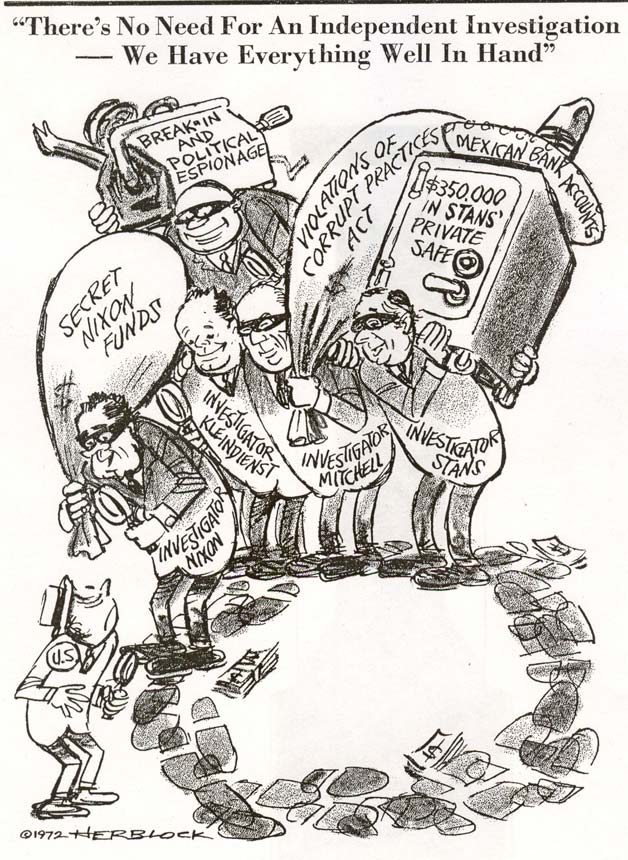
– September 8, 1972 “There’s No Need for an Independent Investigation,” Herblock; copyright Herb Block Foundation
Out of the Watergate scandal came an unrelated revelation: hundreds of companies had illicitly funneled millions of dollars to foreign agents and officials. Few doubted that such payments should be prohibited, but many wondered about jurisdiction and enforcement. Some considered protecting the integrity of financial reporting more important than prosecuting bribery. Political friction abounded as Congress, the U.S. Securities and Exchange Commission and the Ford Administration all grappled with these issues.
Stanley Sporkin, SEC Enforcement Director, was watching the Watergate hearings when he realized that the corporate political payments being discussed must have been made without proper disclosure. His staff uncovered secret slush funds that had been used not only for political purposes but also for commercial endeavors abroad. On March 8, 1974, the SEC demanded disclosure from corporations making illegal contributions. Public awareness of the questionable payments issue was heightened by the 1975 suicide of United Brands executive Eli Black. The scandal burgeoned through the summer as one industrial giant after another came under scrutiny. As one investigator put it, “I wouldn’t say the whole Fortune 500 made illegal payments, but maybe the Fortune 250 did.” (18) did. As a few companies initiated internal reforms, more scandals emerged, including influence peddling in Pakistan, Greece, West Germany, Australia, the Netherlands, and many others.
The most notorious scandal involved the Lockheed Aircraft Corporation. After finding references to a “Lockheed-type” operation in the files of competitor Northrop, the SEC began investigating, as did a committee led by Senator William Proxmire (D-Wisconsin). In August, Lockheed admitted disbursing over $200 million to foreign consultants during the previous five years. Some $106 million went to Saudi Arabia alone. (19) Lockheed’s bribes to a former prime minister sparked a political scandal in Japan. These revelations sent the SEC, Congress and the President searching for a solution.
Securities Act Release No. 5466. New York Times, “SEC Says Northrop Kept $30-Million Secret Fund,” April 4, 1975. New York Times, “U.S. Is Broadening Study of Company Gifts Abroad,” June 9, 1975.
New York Times, “U.S. Is Broadening Study of Company Gifts Abroad,” June 9, 1975. New York Times, “Proxmire Says Lockheed Bribed Foreign Officials,” August 11, 1975. New York Times, “Lockheed Documents Disclose a $106-Million Saudi Payout,” September 13, 1975.