
In the fall of 2024, the Financial Industry Regulatory Authority (FINRA) donated a collection to the SEC Historical Society documenting the events and initiatives that led to the creation of the organization known until 2007 as the National Association of Securities Dealers Inc. (NASD) and thereafter as FINRA.
While the virtual museum and archive already contains primary and secondary sources on this subject (See the “Born Regulated” section of the exhibition “The Institution of Experience: Self-Regulatory Organizations in the Securities Industry, 1792-2010”), the FINRA Donation offers a detailed account of the origins of the first Self-Regulatory Organization (SRO) created under the supervision of the Securities and Exchange Commission—an entity intended to harness the expertise of the industry itself to help safeguard the integrity of the nation’s capital markets.1
The story begins with passage of the National Industrial Recovery Act in 1933, an early effort by the Roosevelt Administration to pull the nation out of the Great Depression. The Act was intended to bring order out of the supposed chaos of competitive capitalism—to halt overproduction, allocate what was produced, and stabilize wages. The mechanism to accomplish this were “codes” drafted and implemented under government supervision by groups representing each industrial sector. Many businessmen grudgingly accepted the plan since it had the potential to stop the ruinous price-cutting touched off by the Great Depression.
Among these were participants in the Over-The-Counter (OTC) market, a network of mostly small broker dealers who sold securities off the exchanges. Their business had suffered from unscrupulous entrants into the market, secret rebates, and other schemes. The 22-year-old Investment Bankers Association of America drafted the OTC code along with government officials, and by May 1934 had created an Investment Bankers Code Committee (IBCC) with an Executive Code Committee overseeing the work of Regional Committees. Some 2,200 OTC broker-dealers approved the plan. Only 44 objected.2
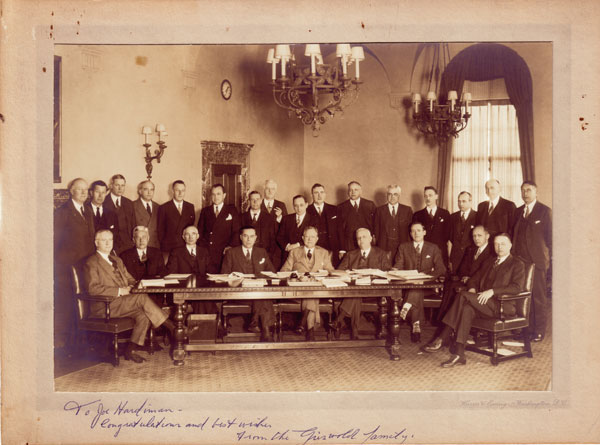
The IBCC worked closely with the National Recovery Administration (NRA) and the SEC to develop rules for OTC market. While federal officials advocated a more punitive approach than the industry did, within six months the two sides reached a general agreement. At the time, the IBCC managing director advised whole-hearted support by the broker dealers:”4
“It is so easy to point out one defect in the Code and one or even many cases of non-compliance…it is absolutely necessary that the business stay with it and support it and not be discouraged by the many obstacles of indifference and misunderstanding.” – Rollin Wilbur, Managing Director of the Investment Bankers Code Committee, July 15, 1934.
By August 1934, IBCC registration with the NRA was mostly done, with 2,754 members in 17 Districts. 5,6 As it sought to rationalize the OTC market, the IBCC developed examinations to ensure that its salesmen were qualified and trustworthy.7 Regional enforcement officials worked to keep dealers from offering discounts that undermined the market.8 All the while, IBCC executives, working through a “Committee to Cooperate with Securities and Exchange Commission” consulted closely with the SEC, even meeting periodically with Chairman Joseph P. Kennedy. 9,10
Then, in the May 1935 Schechter v US decision, the Supreme Court struck down the National Industrial Recovery Act. Businessmen in some sectors were pleased. Others, including those in in the OTC market, scrambled to preserve the benefits of organization. Kennedy assured OTC brokers that a skeleton organization was being maintained “to preserve the good things the Investment Bankers Code initiated” and that the Commission would support a renewed industry organizing effort.11
“Such a co-operative plan might well be more effective against dishonest dealings and at the same time give more freedom to the Investment Banker who conducts his business properly,” Managing Director Wilbur told members.12
By August 1, 1935, the two parties had developed what the IBCC called a plan for “a self-regulatory and self-disciplining organization among securities dealers as an economical and effective co-operative measure in enforcing fair dealing in securities transactions.”13
The SEC favored the idea not only because it would help protect investors, but also because the new group would provide an interface with the fragmented OTC market and help the SEC draft more effective rules and legislation. Finally, as Kennedy well understood, this approach would be better than compulsion.14
“It is, of course, to the interest of everyone concerned that as much of the necessary discipline that is to be imposed should be self-imposed.” — Joseph P. Kennedy, SEC Chairman, September 12, 1935.
The SEC Commissioners did not want the OTC dealers to set up an organization de novo. They favored a “consultative or conference committee” that would explore organizational options. Then, once the weaknesses to be remedied were clear, the SEC could push for legislation enabling the new Self-Regulatory Organization (SRO) to exert control over its industry.15,16,17 On the day that Kennedy resigned as Chairman in September 1935, the SEC and IBCC agreed to form an interim “Investment Bankers Conference Committee.”18 The new IBCC was operational by late October.19
The two immediate tasks facing the OTC market were to devise rules of conduct and to resolve the question of “segregation” of agency and principle functions. 20 By October 1937, the IBCC and SEC had agreed upon a set of OTC rules.21 Segregation took more consideration. OTC market participants traditionally acted alternatively as brokers or dealers. While they believed that this provided flexibility and enabled the market to function, the SEC believed that this inherent conflict of interest should be resolved by compelling participants to “segregate” their functions—to act only as a broker or a dealer. In the end, the SEC stopped short of segregation, insisting only upon “clear and unequivocal disclosure to customers of the capacity in which broker-dealers are acting.”22 Meanwhile, the IBCC drafted a new constitution and became the Investment Bankers Conference, Inc., (IBC) in May 1936.23,24A

After two years of experience, the IBC and the SEC decided that the time had come for legislation. On January 17, 1938, Senator Francis T. Maloney introduced S. 3255, drafted largely by the SEC, “To provide for the establishment of a mechanism of regulation among over-the-counter brokers and dealers operating in interstate and foreign commerce or through the mails comparable to that provided for national securities exchanges under the Securities Exchange Act of 1934.”
This was only a starting point.26 The IBC formed a special committee (composed mostly of members of large firms) to revise the bill. Committee members were willing to work with the Commission but hoped to keep as much autonomy as possible.27 They believed that the SEC bill was not “limited to those principles of self-regulation that the industry envisioned” and began laborious negotiations.28,29 Among the changes the IBC sought were introduction of more nuanced phrases like “willfully violated” in place of just “violated.”30
The IBC had considerable leverage in these negotiations because the SEC Trading and Exchange Division admitted a lack of detailed knowledge about the OTC market.31
“The Commission does not possess detailed information as to the nature and extent of trade practices on the over-the-counter market. Therefore, before the Commission reaches the rule-making point, it would seem desirable to obtain the industry’s reactions and suggestions on the points involved.” – Sherlock Davis, Assistant Director, SEC Trading and Exchange Division, June 1, 1938.
The “Maloney Act” amending the 1934 Exchange Act to create the legal framework for a new type of SRO under SEC supervision, was signed into law on June 25, 1938.
As OTC broker dealers prepared to register under the Maloney Act, one significant hurdle remained. Previous organizational efforts had been spearheaded by members of large firms. Members of smaller firms feared that a new organization would be dominated by “large Eastern houses” and seriously considered creating their own regional SROs.32 Chairman William O. Douglas advised the IBC to “proceed in organizing under the Bill from the bottom up rather than the top down.”33 The Commission even insisted that the group hold new officer elections after registering “to make everyone feel he has gotten a real chance to vote.”34
The IBC convened a new, more representative committee to help frame the SRO.35 In March 1939, the group presented a constitution to its members.36 After some adjustment, the members voted overwhelmingly in favor. On August 7, 1939, the SEC granted registration to National Association of Securities Dealers as the first, and for many years only, SRO under it is supervision.37
Since that time, the organization has embraced an ever widening portfolio of responsibilities including administering examinations, resolving investor-broker disputes, creating the nation’s first all-electronic market, and most notably taking on primary supervision of exchange as well as OTC participants, the event that spurred the renaming of the organization to FINRA in 2007.
For a detailed account of the framing of the Maloney Act, see Committee Story (Maloney Act) included in the FINRA donation.38 Also, peruse the key of 93 documents in the collection (copy and paste the URL for the FINRA file you want to view from the Index list into your browser.)
Sources
2 1934_00526_NRA-Approval-of-Budget.pdf
4 1934_0715_General Outline of Code Activities
6 1934_Investment Bankers Code Committees Map
8 1935_0116_WilburMembers w attachments
9 1935_0117_Report of Managing Director
13 1935_0801_Investment Bankers Move to Save Code
14 1935_0912_KennedyGriswold w attachments
15 1937_0401_FultonGoverning Committee
17 1936_Statement of SEC Chairman on IBCC w attachments
21 1937_0804_Press Release on OTC Rules
22 1936_0624_Segregation in the Over-The-Counter Markets
24 1936_0514_Minutes of IBCC Meeting
25 1938_0621_governing_investment
26 1938_0104_FultonMembers w attachments
27 1938_0201_Memo to Governors
28 1938_0221_FrothinghamMathews
29 1938_0226_FrothinghamGovernors
30 1938_Statement and Resolution on the Maloney Bill
31 1938_0601_Over-the Counter-Problems and the Maloney Bill
33 1954_1116_Maloney Act Memo w attachments
34 1938_1013_Memo of the Reaction of the Commission
35 1938_0723_Press Release No. 1801
38 1954_1116_Maloney Act Memo w attachments
This Spotlight was written by Dr. Kenneth Durr, SEC Historical Society historian.