
Breeden Commission
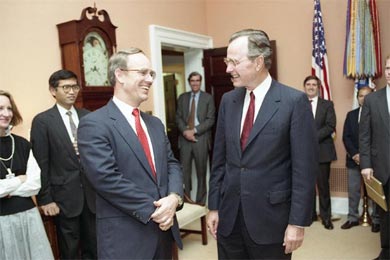
President George H.W. Bush, who had served as Reagan’s Vice President for eight years, had previously been a U.S. Representative from Texas, envoy to China, and Director of the Central Intelligence Agency, brought to the Oval Office deep prior experience and appreciation about how government worked. Bush’s view of a “kinder and gentler government” would mesh with his commitment to conservative regulatory policies. With the U.S. Securities and Exchange Commission, Bush would shape its work by handing its reins to Richard Breeden, who had proved himself an able colleague.
Breeden had previously served during Bush’s Vice Presidency and was appointed as one of Bush’s 12 Assistants to the President. Bush selected Breeden to manage the rescue of the savings and loan industry. Breeden coordinated the legislative effort to create the Resolution Trust Corporation, which bought the assets of failed savings and loan institutions, comprising nearly a third of all U.S. S&Ls, to keep the industry afloat. Edward Fleischman noted, “Richard Breeden was a longtime assistant to the new President, and the guy who was credited with awakening every day and saying, ‘How can I get FIRREA (Financial Institutions Reform, Recovery and Enforcement Act of 1989) one step further down the road to passage in the Congress?’ That was very important to the President. So the appointment of Richard as Chairman of the SEC was the selection they wanted.”39
Breeden was eager for the challenge. In a memo to Chief of Staff John Sununu, Breeden stated his qualifications for the office, the challenges facing the SEC and his motivation for service: “The SEC has been generally slipping from its traditional position of preeminence among independent agencies, in part due to leadership problems at the top. The vacancy of the Chairman and several of the Commissioners this year offers the opportunity to rejuvenate the entire Commission. I would provide strong leadership, with support in the White House being seen as a major plus for the Commission.”40
Before Breeden took the oath as SEC Chairman, he requested a meeting with President Bush in the White House mess. He recalled that “President Bush was confident in my judgment and my experience. He said I always want you to be sure that you do what you think is right and not what you think is expedient, not what you think is easiest.”41 That trust and confidence would give Breeden the flexibility to run the SEC his way.
Breeden understood the markets and how excessive regulation could undermine the ability to raise capital. His approach to regulation was pragmatic, and he worked to achieve consensus among staff. Richard Roberts remembered, “Chairman Breeden – for a Republican, you wouldn’t think this – was a real strong protector of shareholder rights.”42
Breeden made a significant change to the work of the SEC when he determined that international affairs would move from the Division of Enforcement, and be established as a separate office, headed by Michael Mann. That change was prescient in light of one of the least anticipated, but most significant events in the second half of the 20th century: the end of the Cold War. The collapse of the Soviet Union opened up opportunity for economic freedom. Up to then, the SEC had limited global reach. When former communist countries asked the SEC for assistance developing their own style of market capitalism, Breeden put into practice what he referred to as “his Ph.D. in political leadership,” obtained from his service at the White House. The International Institute on Securities Market Development was Breeden’s brainchild. The Institute provided the foundational training for many newly-freed free-market proponents, welcoming foreign officials who had little experience, but an immense appetite, to learn about the U.S. markets and their regulation. Institute graduates returned to their home countries, where, for half a century, no free markets existed, and began to construct their own free-market systems. Michael Mann remembered that, “In every country, we went to, we would meet in the chairman’s office, and he would have the Institute diploma up on his wall, next to the authority granted by his government to be chairman. I remember Arthur [Levitt] turned to me and saying, ‘The power of this is greater than one could ever have imagined.’ It changed the way the SEC was perceived also.”43
As SEC Chairman, Breeden understood that, while regulations were necessary, if they cost capital formation more than their general benefits, the SEC should not pursue them. Business interests appreciated his pragmatism. Pro-regulators found much to like in his willingness to expand SEC authority where fraud went unprosecuted. Although characterized for personal brusqueness and a penchant to not just “pick his battles; he wanted to fight them all,” he exhibited considerable skill as Chairman. “Richard Breeden was chosen because he had been such a good friend of George H.W. Bush, he had done brilliant work for ’41, he had been a good friend of Darman and Sununu and others in the White House, and Republicans on the Hill like Warren Rudman, not an easy task. It’s not something you do if you lack personal sensitivity. In other words, the characterization that Richard has the skin of an elephant runs out at some point. He’s been pretty good at making people of very different kinds think he’s a valuable friend and ally.”44