
Levitt Commission
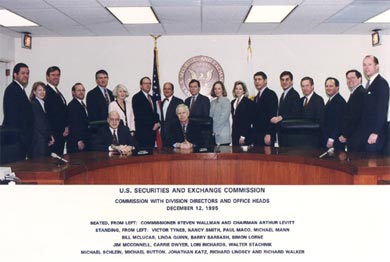
President William J. Clinton, who had campaigned as a new kind of Democrat, nominated Arthur Levitt, former Chairman of the American Stock Exchange, as SEC Chairman. Levitt would lead the SEC throughout Clinton’s two terms, becoming the longest-serving SEC Chairman to date.
President Clinton’s hands-off approach to the SEC “showed respect for the independence of the agency.” In turn, Levitt was committed to a Commission that was “apolitical from the beginning” and “ruthless in terms of committing to a non-political environment.” Levitt himself was viewed as “the most politically astute Chairman, certainly in the modern era of the SEC. On difficult issues, he had a capacity to deal with people who ideologically were completely opposed to a perspective he had, or an initiative he wanted, and he could bring them around in a way that was remarkable.”45
Levitt began by reaching out to SEC staff. “I spent an inordinate amount of time with each key staffer. I met with them, I went to their offices, I consulted with them. I waged a campaign to win them over. I spoke about them as patriots, underpaid and overworked. I did everything humanly possible to win their confidence.” Many who worked with him returned his esteem. “Working with Arthur Levitt was one of the great pleasures of my professional life. Arthur was an extraordinarily effective Chairman. He has remarkable leadership skills, immense concern about investor protection and the integrity of our financial markets, admirable courage, and unmatched practical insight and wisdom.”46
Levitt’s approach was to set goals and to encourage both staff and the industry to suggest ways that they could be achieved. During his Chairmanship, the SEC helped to reform the regulation of municipal finance, protect the independence of the accounting standard setting process and of auditors, and improve the quality of financial reporting through Regulation FD.47 His Commission colleagues recognized his impact. Richard Roberts recalled, “[Chairman Levitt] really changed market structure probably more than any Chairman in modern history,” while Steven Wallman noted, “In terms of the municipal securities areas, Chairman Levitt’s efforts were extraordinarily laudable.” Laura Unger remembered, “Arthur was pretty ahead on [auditor independence]. I wasn’t as focused on what he was doing with his speeches – finding the accounting issues incredibly dull, quite honestly. But when I read it in context now, I have to give him a pat on the back for that.”48
The SEC staff also saw the initiatives he encouraged. Robert Plaze noted, “If I think back to the Arthur Levitt years, what I think of mostly is how the Commission at a very early stage hitched itself to the Internet. He recognized before I think anybody else at the Commission did, how important this was going to be, and took steps to upgrade and modernize the laws to accommodate this.” For Susan Wyderko, it was the Plain English initiative. “He would award gobbledygook awards periodically to something that someone had picked out of a disclosure that was just incomprehensible. He was using his bully pulpit as a force for good.” Paul Roye remembered, “Chairman Levitt was always out meeting with investors. He did town hall meetings and he could hear firsthand from investors what they were concerned about.”49
In 1994, the Republican Party gained control of both houses of Congress for the first time since the 1950s, leading to budget impasses between Congress and the Clinton Administration and resulting in Federal government shutdowns in both 1995 and 1996. In 1995, Congress enacted the Private Securities Litigation Reform Act, despite SEC opposition and President Clinton’s veto. A larger issue was the on-going effort to repeal the 1933 Glass-Steagall Act. Repeal supporters in Congress saw an opportunity to connect their aspiration to make American banking globally more competitive with the Clinton Administration’s goal to expand housing for middle and low-income Americans. In the legislative efforts leading to the passage of the Gramm-Leach-Bliley Act in 1999 repealing Glass-Steagall, the SEC worked to retain its power to regulate securities activities, while bank depository activities would be handled by banking regulators.50
Before departing the SEC with the end of the Clinton Administration, Levitt issued a warning to staff. “Arthur Levitt, I remember him saying in staff meetings, ‘Aren’t you guys worried? This is just crazy stuff. People are saying it’s the new economy and who worried about cash flow and whether you make money or not? It’s all something different.’” Looking back, Levitt concluded, “I was the luckiest Chairman in the history of the Commission.”51