
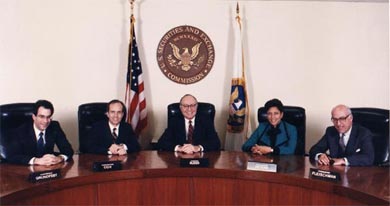
David Ruder of Northwestern University School of Law was President Reagan’s choice to serve as his second SEC Chairman. Ruder recalled that, “I was a professor and this was at the beginning of the Reagan Administration’s difficulty over Iran-Contra and the Administration wanted somebody who was non-controversial.” Ruder went to the SEC thinking, much like the Reagan officials who vetted his appointment, that he would be less regulatory than he turned out to be, and more regulatory than the White House thought he would be.31
Ruder continued the insider trading actions remaining from the Shad Commission. U.S. Senator Donald Riegle, Jr. (D-MI), Chairman of the Senate Committee on Banking, Housing and Urban Affairs, had formed an outside group of experts to advise on formulating a specific definition of insider trading. The SEC opposed creating a specific legal definition, preferring to rely on administrative rule-making to address the problem. The committee, chaired by former SEC General Counsel Harvey Pitt, drafted new legislation in negotiation with the SEC. Their work led to passage of the Insider Trading and Securities Fraud Enforcement Act (ITSFEA), with Chairman Ruder advising the Senate of a willingness to compromise between the SEC’s position and that of the committee.32
Aulana Peters saw that Ruder “wasn’t ideological in his approach to market regulation. His approach was, if there’s a problem, will regulation fix it?”33 That mindset animated the SEC’s work in such diverse areas as international accounting issues and the formation of the Penny Stock Task Force. To combat fraud in the market for penny stocks – stocks that trade for less than a dollar – the SEC convened the task force, enlisting the aid of the North American Securities Administrators Association. SEC regional offices collaborated with state regulators to share information about penny stock manipulation and educate investors about fraudulent practices.
But the major action of Ruder’s Chairmanship happened outside of the control of the SEC. On Friday, October 16, 1987, anxiety in the markets, coupled with the “triple-witching” – an event that occurs four times a year when stock index futures, stock index options and stock options all expire on the same day, caused the Dow Jones Industrial Average to drop 4.6%. On Monday, October 19th, the market dropped 508 points, or 22.8%, up to that time the largest one-day drop in history. That day, Ruder had given a speech in Washington, and Richard Ketchum, Director of Market Regulation, was in New York City. Ketchum recalled: “I talked with Dave [Ruder], talked with my staff, and thought, ‘I’m in the wrong city.’ I headed to the airport to get back to Washington. I got back and stood with my staff. And again, a picture of the SEC at the time: The Chairman’s office had literally no market terminal, absolutely none. So Market Reg – as primitive as our setups were with our couple of Reuters and Bloomberg terminals – was the focal point. Dave Ruder came down; Ed Fleischman, Joe Grundfest, three of the Commissioners at the time, gathered around us. I remember the spooky feeling where, in the silence, you watched the market just go down. In today’s terms, there was never any green ink on the screen. It was always red.”34
Ruder received a telephone call later that evening from Senator Riegle, asking if he would call President Reagan to tell him to make a statement to calm the markets. Ruder, thinking it presumptuous to tell the President what to do, instead called a White House staff member whom he knew well. The President did not make a statement.35
The next day was even more challenging. Ruder later stated that “the noon time period on October 20 stands out as the most memorable moment in my time as Chairman. The nation’s securities markets came close to collapse, with potential catastrophic consequences.” Ruder remembered that John Phelan, Chairman of the New York Stock Exchange, called to inform the SEC that the markets would close and asked for the Commission’s support. John Phelan’s recollection was that he called the White House and the SEC simultaneously, stating his determination to keep the markets open. Christopher Cox, who was serving in the Reagan White House, remembered that Chief of Staff Howard Baker asked on what authority he could insist the markets stay open; his response was “Tell them that the President of the United States wants to keep the markets open.”36
The markets remained open, and Ruder was called to the White House. Chief of Staff Howard Baker informed Ruder that the Administration believed there should be high-level discussion on what should be done about the markets, leading to the formation of the President’s Working Group on the Financial Markets. But the damage to public confidence in the capacity of the SEC to protect investors against massive market moves had already been done. Ruder bore the brunt of the SEC’s response to the market break. He spent a major part of the remainder of his Chairmanship on Congressional testimony and oversight of staff studies on what had happened. As the George H.W. Bush Administration succeeded the Reagan Administration, Ruder was further marginalized. “Dave Ruder had – infuriated is too strong a word – alienated the Bush White House. I didn’t know what the relationship was between them, but they had been fairly nasty to him.The last appointment that was made when he was Chairman was the appointment of a person whom he really didn’t know. He took it as a personal slap, and I think had I been he, I would have too. But that was what was going on between the Chairman’s office and the White House at the time.” 37
In early February 1989, Ruder read in The Bond Buyer that he would not be reappointed. He asked for a meeting with the White House, where he was informed that President Bush would replace the heads of all independent agencies, except for Wendy Gramm at the Commodity Futures Trading Commission. Ruder recalled that he “did not send in my letter of resignation. I did not resign. I did nothing.”38 But by late summer, the White House had selected his successor.