
The continuing efforts to reduce the size of government and its impact on a growing and increasingly complex financial industry came to a climax in the George W. Bush Administration, exposing both the promise and the practical effects of financial deregulation.
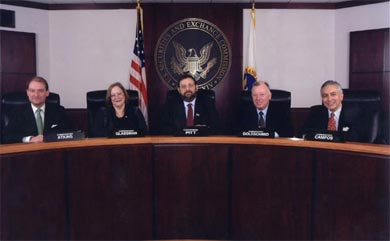
President Bush chose Harvey Pitt, former SEC General Counsel and a leading securities practitioner, as SEC Chairman. Within a month of taking office, Pitt faced the attacks of September 11, 2001 on the United States. As the World Trade Center towers fell in New York City, the impact on the securities industry was dramatic. Most of the Wall Street area had no utilities or communication services and was covered in debris. Several billion dollars of physical securities were destroyed. The Seven World Trade Center building, which housed the SEC New York Regional Office, later collapsed with no fatalities. “The most extraordinary thing that Harvey did … is that he sized up the situation quickly and said, ‘The people who are best equipped to handle this are Dick Grasso and the broker-dealer community, the financial community,’ and he got the hell out of the way. If you know Harvey, he doesn’t get the hell out of the way very easily, and it was one of the finest things he ever did. He managed an agency response that was extraordinarily constructive and useful.” Pitt worked to ensure the reopening of the markets on September 17th and the resumption of the SEC New York Regional Office’s work, recalling that “it was a proud moment for the agency when, in October 2001, the Commission became the first federal agency to move back into New York’s financial district, a stone’s throw from Ground Zero.52
But Pitt’s handling of the markets in the aftermath of 9/11 proved to be the high point of his Chairmanship. In late 2001, disclosures of accounting fraud by Enron, and then WorldCom and Tyco in 2002, brought into focus problems within the accounting industry. Pitt’s representation of the industry in private practice appeared to be a detriment in the SEC’s response. “I think Harvey came in focusing on trying to relieve the pressure on the accounting industry, and didn’t focus enough about the fact that there was a serious accounting problem…and did not react to the broader need, did not see the broader need.” Pitt drew fire for refusing to recuse himself from SEC enforcement cases involving companies and accounting firms that were once his clients.53
President Bush looked to the SEC to implement a response to the accounting scandals, without the need for legislation. But Democrats in Congress argued that a response without legislation would be inadequate. As 2002 was a midterm election year, “there was enormous concern in the White House and among Republicans that this crisis was going to damage their chances in November.” The subsequent bipartisan Sarbanes-Oxley Act of 2002 was signed into law, prohibiting an accounting firm from providing audit work for a public company while contemporaneously providing a host of other services. The act required each public company to have an audit committee composed of independent directors, and required attorneys for public corporations to report material violations of law to the corporation’s chief legal advisor and/or the CEO. “Given the political environment in late 2002, the Commission to a person endorsed Harvey Pitt’s position: the Commission will do what Congress has told it to do. We will implement Sarbanes-Oxley. We will do it in the time frames, which were by and large six months, that Congress has imposed. ‘Is this is good idea, is this a bad idea?’ disappeared from the conversation. Congress had spoken.” 54
One of the provisions of the Sarbanes-Oxley Act was the creation of the Public Company Accounting Oversight Board (PCAOB), which would be under the oversight of the SEC. John Biggs, TIAA-CREF Chairman, had been the Commission’s initial choice to chair the agency. But Pitt recommended William Webster, former FBI and CIA head, as a candidate without consulting his fellow Commissioners. The selection was debated in an open and contentious Commission meeting, with Commissioners questioning the qualifications and vetting of the candidates, before ending with “a 3-2 vote, the three Republican Commissioners with Chairman Pitt, and Judge Webster was voted as chair.”55
A few weeks later, Judge Webster stepped down from the PCAOB after revelations that he had headed the audit committee of a firm under SEC investigation for accounting irregularities, a fact shared with Pitt before the Commission vote. The White House, while supportive of Webster’s candidacy, had not been informed of the investigation. By then, Pitt himself had resigned, mindful that “the [Administration] wasn’t happy with the way he handled things. He was totally aware that they may replace him.” Cynthia Glassman reflected, “I think Harvey believed that he hadn’t done anything wrong – which in fact, he hadn’t – and so he didn’t have to explain himself, which he probably should have. It might have helped.” Roderick Hills considered, “He has all the capacity in the world. He certainly has the integrity to deal with it, but I guess you’d have to say he didn’t have the personality to deal with it, and that’s the sad part of it.” Laura Unger concluded, “He was just the wrong person for the wrong time.”56