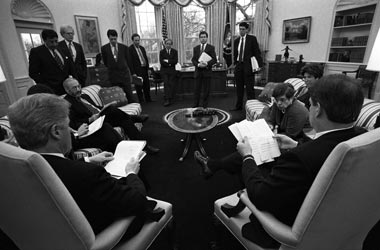
March 19, 1996 Meeting of economic advisors with President Clinton and Vice President Gore (backs to camera), including Joseph Stiglitz (seated, left); Leon Panetta (standing behind Stiglitz); Lawrence Summers (standing fourth from left); Jacob Lew (standing, right of desk), and Alice Rivlin (leaning forward, right); courtesy of the William J. Clinton Library
The most sustained debate over Glass-Steagall restrictions prior to the actual repeal occurred during the tumult and aftermath of the savings and loan (S & L) crisis of the 1980s. The deregulatory atmosphere of the political climate provided the catalyst for supporters of those reforms.
Central to the debate was the fight over what came to be known as “non-bank banks” — banks that perform financial functions other than traditional depositary and lending functions, such as selling insurance, and marketing securities, including money market accounts. At issue was whether banks could create separate institutions that performed non-traditional financial and securities functions, and at what level and under which regulatory scheme such organizations would be permitted.
The Garn-St. Germain Depository Institutions Act of 1982 permitted increased opportunities for banks and S & L’s to offer a wider array of savings products as well as permit broader lending authority with less supervision. 31 Savings and loans began competing for deposits by offering high-interest rates on money market accounts so that they could use the deposits to lend to real estate developers. In some cases, the banks themselves became de facto developers.
By the late Eighties, many S & L’s real estate assets were seriously devalued. The Resolution Trust Corporation, which was set up by Congress to assess the viability of S & L’s, closed over 1,300 institutions and paid over $160 billion to settle insured depository accounts.
The reaction to the S & L crisis led to the passage of the Financial Institutions Recovery, Reform and Enforcement Act (FIRREA) in 1989. 32 An element of the debate over FIRREA was the proper sphere of regulation of “non-bank banks.” Proponents argued for the repeal of separation of traditional banking from new and innovative businesses, such as dealing in insurance and in securities marketing, as essential to create competition among institutions. Market competition was viewed as a sufficient regulatory tool to protect investors and consumers.
Big banks argued that they could not be competitive with international banks free from U.S. regulation unless Congress permitted them broader investment and marketing options, including the sale of securities. Smaller banks, many that had developed insurance-related businesses, also sought expansion. National securities firms, however, opposed any expansion in banking regulations, warning that it would lead to risky losses that threatened the safety of federally-insured deposits.
Senator William Proxmire, an advocate of the Glass-Steagall firewall, threatened to filibuster the recapitalization of the Federal Savings and Loan Insurance Corporation essential to putting the industry back on firm footing, unless Congress agreed that “eliminating limited service banks (non-bank banks) was just as important as recapitalizing the Federal Savings and Loan Insurance Corporation.” 33
Proponents of “non-bank banks” opposed characterizing the S & L crisis as the reason to stop the expansion of securities and financial business to national banking institutions. Their arguments would form an intellectual foundation for Glass-Steagall’s eventual repeal. In the end, Congress funded the S & L bailouts and the decision permitting the expansion of bank powers was delayed for further study.
In 1987, the Congressional Research Office published “Glass-Steagall: Commercial vs. Investment Banking,” presenting the pros and cons of repeal. 34 Conflicts of interest, increased financial power and lending risks, and the potential for enormous losses were counterbalanced by the issues in favor of deregulation: the distinction between loans, deposits and securities was seen as minimal; securities were perceived as a low-risk business by banks; and the world-wide deregulation of depository institutions made U.S. institutions less competitive. The arguments presented in the report would later resound in the debate surrounding the repeal of Glass-Steagall in 1999.