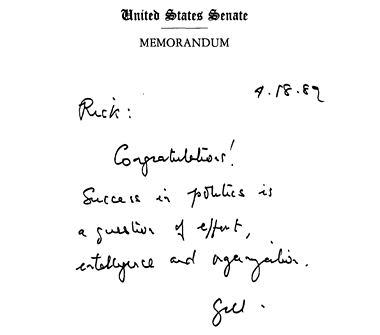
April 18, 1989 Note to Richard Carnell from U.S. Senator Donald Riegle; courtesy of the National Archives and Records Administration
In 1984, before the scandals emerged and largely at the behest of the SEC, Congress passed the Insider Trading Sanctions Act of 1984. That legislation strengthened the penalties for violating existing federal securities laws and authorized the SEC to collect a new civil penalty against persons for violating insider trading rules. President Reagan stated that “abuses by insiders and those who receive tips erode investor confidence in the securities markets…(making) public investors less willing to place their money at risk if they believe other traders, unlawfully utilizing material nonpublic information, have unfair advantages.” 20
Those changes had been drafted by the SEC, acting proactively to address court cases that appeared to make their effort to fight insider trading more problematic. Yet in 1987, when insider trading scandals exploded in the public consciousness, it was Congress and not the SEC that led the reform effort. Before, SEC experts proposed legislation to a willing Congress; by 1987, in reaction to the public crisis, experts in Congress took the lead in drafting and pushing insider trading reforms.
Several factors help explain why the influence of the SEC with respect to the new legislative effort diminished. During the early 1980s, SEC Chairman John S.R. Shad opposed major increases to the SEC’s budget. Only when the insider trading crisis roiled public consciousness did Chairman Shad request increased funding. 21
After Shad’s retirement in 1987, President Reagan appointed David S. Ruder, a Northwestern University Law School professor with substantial experience in securities law, as Chairman. That fall, on October 19th, the Dow Jones Industrial Average dropped 508 points, or 22.1 percent of its full value. This single-day market drop, in the midst of high-profile insider trading scandals, undermined investor confidence, and caused Congress to jump to the forefront of a legislative response to the situation. Critics in Congress argued that the SEC failed to prevent insider trading abuses and the market break. Faced with a deluge of constituent concerns, Congress responded with an activist legislative agenda.
As Congress took control of the agenda, the expertise of both individual members of Congress and long-term committee staff grew. On the Senate Banking Committee, Steven Harris and Richard Carnell exerted considerable legislative influence. Their long experience in financial and securities legislative matters made them invaluable. Their institutional knowledge of the law and of the legislative process put them at a significant advantage over the SEC in offering advice on pending legislation. The legislative memos they prepared provided reasoned advice on specific provisions of the legislation, but also on legislative strategy for upcoming hearings. The extent and scope of their knowledge about the legislative process and the complications facing Congress as it navigated a bill to passage made them enormously influential. 22