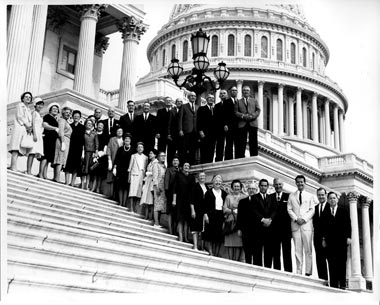
1971 Speaker of the House Carl Albert (lower right) with constituents on the steps of the U.S. Capitol; courtesy of the Carl Albert Center, University of Oklahoma
Carl Albert, affectionately known as the “little giant” (he stood 5 feet 4 inches), served as U.S. Representative (D-OK) from 1947 to 1977 and as Speaker of the House during some of our nation’s most difficult times during the Seventies. His archive demonstrates the serious and substantial nature of the economic issues of the nation during his Speakership.
The connection of the public to their representatives is not new; from the inception of our republic, citizens have petitioned Congress. Yet there is something distinctive that appears in the papers of Speaker Albert — courtesy, a respect for difference of opinion, and clarity of purpose on issues. The correspondence between Speaker Albert and his constituents seems less contentious and more open to compromise than current times.
One letter from Cecil Martin, who calls himself “an average person,” begins by invoking “Gods (sic) blessings upon you, your family, and by the time you get this your new job as Speaker of the House” before it questions whether “all the people who must vote on these complicated issues really understand them completely.” Complaining about “riders” in bills, Mr. Martin wonders why that process occurs, suggesting that “a major bill should stand or fall on its own merits.” 6
A telegram sent to President Nixon and copied to Speaker Albert complained about the 1969-1970 stock market crash as “tragic and disastrous to most investors.” At the copied line on the letter, Speaker Albert underlined his name, and in his handwriting wrote “Please Assist. C.A.A. Jr.” 7
Speaker Albert gave his personal attention to letters from citizens across the country on all manner of issues, including Citicorp bonds, federal monetary policy, individual investment concerns, the Investment Advisers Act and consumer protection. His constituent letters were courteous and clear replies that detailed his positions, regardless of his agreement or disagreement with his fellow citizens’ concerns.