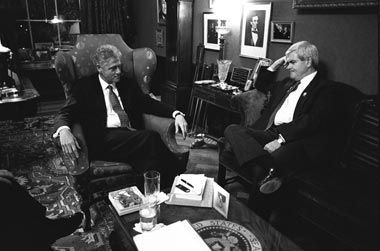
October 28, 1997 President William J. Clinton and Speaker of the House Newt Gingrich; courtesy of the William J. Clinton Library
The U.S. Securities and Exchange Commission is an independent regulatory commission, separate from Presidential administrations. It would be a mistake, however, to assume that Presidents do not also assert influence on securities and financial legislation.
Presidents, like Congress, must respond to the impulse of current events and act to avert crises. Economic crises, especially those that affect the investing public and their financial interests, compel Presidents to act. When that happens, the administration in power seeks to work with Congress and the SEC to implement legislation to address public concerns.
Some Presidents, as part of their economic policy or philosophy, support more fundamental changes, moving the pendulum to either greater or lesser regulation. President Reagan came into office on a platform that advocated eliminating layers of government regulation, including those affecting the financial markets, as one of his pillars of economic recovery.16 A President’s agenda may create a conflict between members of Congress and the SEC, when administrative policies come into conflict with the objectives of Congress or the Commission.
However, not all Presidents take a proactive role in financial legislation. Initially, President Clinton was not an active participant in the on-going debate over the repeal of Glass-Steagall. It was only after a push from Congress that he formed the President’s Working Group on Financial Markets in a belated attempt to shape the administration’s position and influence the proposed Congressional reforms.
The process of legislating becomes more complicated when bills which may be favored by the SEC are opposed by the President. The President’s veto power significantly diminishes prospects for enactment for any legislation which the President opposes. 17