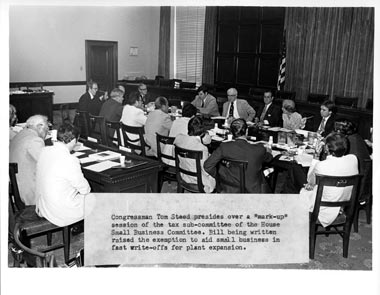
Congressman Tom Steed presides over a “mark-up” session of the tax-sub-committee of the House Small Business Committee. Bill being written raised the exemption to aid small business in fast write-offs for plant expansion; courtesy of the Carl Albert Center, University of Oklahoma
The process of legislating has been one of the most examined areas of political history, yet the behind-the-scenes mechanics remain shrouded in deep public mystery and misunderstanding. In the financial arena, Congress, the U.S. Securities and Exchange Commission, Presidential administrations, and the securities and financial industry represent the sources for its development.
In guiding a particular bill from introduction through enactment into law, the work of Congress extends beyond floor debate to the work of committees in drafting and shaping a bill before it faces determination by the full House and Senate. Members have their own areas of interest, and the Senators, Representatives and Congressional committees that oversee securities and financial legislation develop their special expertise.
Individual members and standing committees regularly take up new legislation responding to ascendant issues. Committees also conduct oversight hearings on the existing administrative responsibilities of regulatory agencies to confirm that the agencies are acting in accord with their responsibilities, ensure Congressional objectives are being met, and address areas where existing law has proved inadequate to new and changing circumstances.
With respect to securities and financial issues, much of which are complicated and intricate, staff members – both working for individual Senators and Representatives and for standing committees – become experts in those areas. Staff members form a cohort of institutional expertise, acting as the mechanics of new legislation and of the oversight of existing legislation, and educating Congressional members and colleagues about the nature and proposed solutions to developing problems. They help coordinate efforts with financial regulators, administration officials and industry lobbyists, and provide information to the financial press to disseminate their point of views. 3
For an analysis of how Congress legislates, using several case studies, see Barbara Sinclair, Unorthodox Lawmaking: New Legislative Processes in the US Congress (CQ Press College: Washington, DC, 2011).