
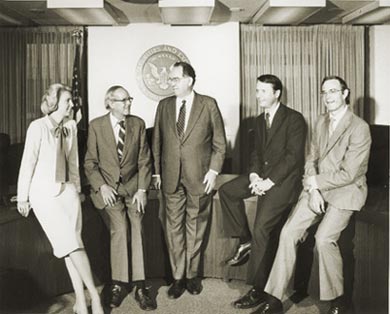
John Shad, a former E.F. Hutton Vice Chairman, was selected by President Reagan as SEC Chairman. John Fedders, whom Chairman Shad appointed as Director of Enforcement, remembered that Shad “had some definite ideas about the administration of the SEC and the administration of justice. He was very loyal to President Reagan. I think he liked politics and it was something that he had never been involved in before.”21
Some SEC staff were skeptical about Shad’s commitment to their work. Joel Goldberg recalled that Shad was “a very, very smart man, but he had really drunk the Kool-Aid of the Reagan philosophy that we’ve got to shrink the government, the fewer rules the better.” Shad saw the SEC’s role, not as the traditional “cop on the corner of Wall Street and Broad,” but as a promoter of capital formation, in line with the agenda developed by the President’s Task Force on Regulatory Relief. He signaled a friendlier regulatory approach by the SEC, disagreeing with the proposition that government had to have an “adversarial relationship with business.”22
He won support from staff with his proposal of shelf registration, “where the issuer can file a registration statement, and on a moment’s notice declare it effective and sell it on the market that day. So his willingness to override institutional memory caused the SEC to be much more responsive to the market.”23
During Shad’s tenure, the SEC concluded the Futures Trading Act with the Commodity Futures Trading Commission. “We were having a real fight with the CFTC, over who was going to regulate financial futures. That was very interesting, because we all thought it should be within our jurisdiction, and they thought it was their jurisdiction. And frankly, I knew they would win, because I knew Philip Johnson was smarter than Shad; he was tougher and smarter. I remember saying over and over again, ‘We should be winning this. There’s no question that we have the primary jurisdiction.’ But I don’t believe that when you get Philip Johnson and John Shad in a room that Philip Johnson will walk out the loser.”24
Despite Shad’s philosophy that hostile takeovers were a good discipline on the market, he convened the Advisory Committee on Tender Offers. While avoiding the question of whether hostile takeovers were inherently good or bad, the Advisory Committee sought both to reduce barriers to takeovers and to end abusive practices associated with them.25
A personal project for Shad was the development of EDGAR, the Electronic Data Gathering Analysis and Retrieval System, which began as a model test program in 1984. “If his wasn’t the first government agency to try to computerize things, it was the second. Especially given the nature of the industry you’re regulating, everything is moving so much faster than it was thirty years ago, not to have gotten out in front of the electronic age would have been just a terrible disservice. So [Shad] deserves credit for that.”26
A challenge to the SEC during Shad’s Chairmanship was the revelation of widespread insider trading abuses. The appointment of Justice Lewis Powell, a former securities lawyer, led to the U.S. Supreme Court’s more active role in insider trading cases, with its decisions in Chiarella v. U.S. and Dirks v. SEC.27 The SEC Enforcement staff brought to Shad evidence of “the Dennis Levine case, and that led to [Ivan] Boesky and to Marty Siegel – and then Boesky led to Drexel Burnham and to Michael Milken – it took a while for the Chairman to process what this meant, because we now had taken a can opener to the investment banking community that he’d come from. It was very difficult for him to come to terms with this and accept it. There was more than one long conversation that Gary [Lynch] had with the Chairman, explaining ‘John, this really happened. We didn’t make this evidence up.’”28
Chairman Shad had “a gut feeling that insider trading was rampant,” but it still stung to uncover fraud in the investment community in which he had worked. “When the first cases came up, he really wanted to whip them hard. Playing amateur psychiatrist, I think he felt betrayed by the Boeskys and the Levines of the world that he knew well. I think he felt particularly betrayed by Mr. Milken.” Shad became “more interested in stringent enforcement. He said he was going to come down on insider trading like hobnail boots.” One insider trading case went straight to the White House. The Enforcement staff found culpability with Paul Thayer, a former Chairman and CEO of LTC, who served as Deputy Secretary of Defense. Shad, who had closely vetted the Thayer case, recommended to staff that they advise the White House, providing briefings to both Fred Fielding, Counsel to the President, and Caspar Weinberger, Secretary of Defense. 29
Shad chose to end his SEC Chairmanship in 1987, and in recognition of his service, the Reagan Administration appointed him Ambassador to The Netherlands. As Karl Barnickol noted, his tenure led to major SEC initiatives, not least that “the SEC stops trying to review everything that’s filed. I think Shad’s regime was terribly important, and it has had a huge lasting impact. He’s been dead for years now, but his statue should be at the SEC.”30